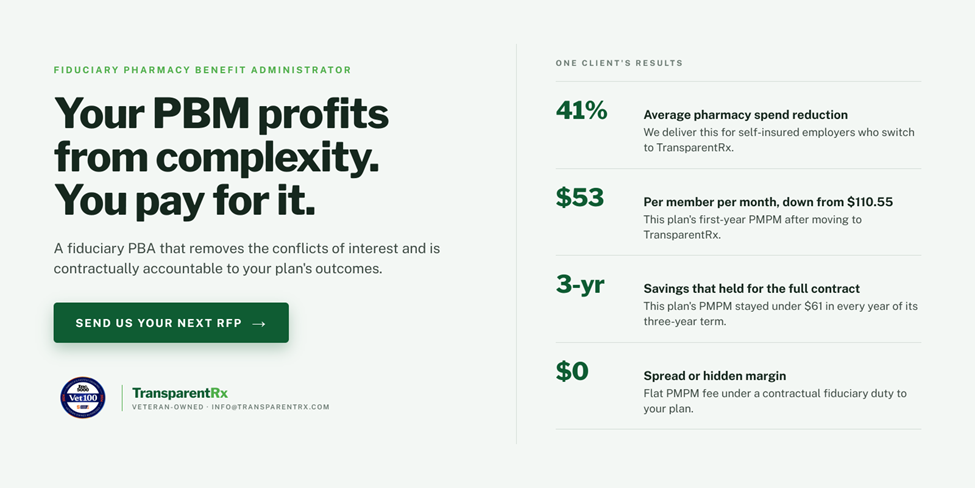
We reduced an employer’s pharmacy costs by approximately 51% and the PBM consultant wanted to know why the rebates were so low. Not why costs had fallen so dramatically or how we achieved those savings. Their concern was that the actual rebates were approximately 50% lower than what we had projected in our original proposal.
During a recent market check, the consultant challenged the difference between projected and actual rebates, despite our having exceeded the contractual rebate guarantees. We had paid more per eligible claim than required, yet the consultant’s fixation on rebate projections overshadowed the most important financial outcome: the employer’s substantially lower pharmacy spending.
We achieved those savings without international mail, patient assistance programs, or other alternative sourcing arrangements. The reduction came primarily from effective utilization management and a value-based formulary that favored clinically appropriate medications with lower net costs. Fewer expensive brand prescriptions meant fewer rebates, which was precisely what we should have expected.
The consultant never meaningfully addressed the employer’s pharmacy cost per member per month (PMPM). The experience reinforced something I’ve been writing about for years. Too many employers and their advisors measure PBM performance by how much money comes back instead of how much money never needed to be spent.
The Problem With Rebate Projections
Our original proposal was developed using the employer’s historical pharmacy claims. Those claims included expensive brand medications that would have been rejected as submitted under our formulary and utilization management requirements. The rebate projections reflected historical utilization, including prescriptions we expected to manage differently once the program was implemented.
When those controls took effect, certain medications were no longer covered without meeting clinical requirements, while others were replaced with clinically appropriate, lower cost alternatives. Those changes reduced pharmacy spending, but they also eliminated rebates associated with the original prescriptions. In other words, some of the projected rebates were tied to claims that would never be paid as originally submitted under our management.
This distinction matters because a rebate projection is not the same as a contractual rebate guarantee. One estimates future rebates based on assumptions about utilization and drug mix. The other establishes a specific contractual obligation. Our per claim rebate payments exceeded the guaranteed amount, even though actual rebates fell below the original projection.
The consultant was effectively questioning why the employer hadn’t received more rebates on spending we had helped eliminate. From my perspective, the more relevant question was whether the employer’s total pharmacy costs had declined without compromising appropriate patient care. By that measure, the program had delivered substantial value.
When Better Performance Looks Like Underperformance
Our experience exposes a weakness in how pharmacy benefit proposals are evaluated. A PBM can substantially outperform expectations on total cost while appearing to underperform against its original rebate projections. Both results can be true because successful utilization management changes the utilization and mix of medications being purchased.
Consider two hypothetical medications with comparable clinical outcomes. Drug A costs $1,000 and generates a $400 rebate, leaving a net cost of $600. Drug B costs $400 and generates a $50 rebate, leaving a net cost of $350. Drug A produces eight times more rebates, but Drug B saves the employer $250 per prescription. Multiply those differences across thousands of prescriptions and the financial consequences become significant.
A formulary that favors expensive brand medications can generate impressive rebates while leaving the employer with a higher pharmacy bill. Conversely, a formulary that reduces unnecessary brand utilization may produce smaller rebate checks while delivering greater savings. An employer can collect millions in rebates while spending millions more than necessary.
Imagine explaining to a CFO that pharmacy spending declined by 50%, but the results were disappointing because actual rebates fell below projections. Most executives would recognize the contradiction immediately. The objective of a pharmacy benefit is to provide access to clinically appropriate medications at the lowest reasonable cost, not maximize manufacturer payments. Net pharmacy costs, utilization, and clinical outcomes are far more meaningful measures of performance than rebate projections alone.
Two Exceptions Worth Making
I’m not suggesting employers should reject every manufacturer rebate. Rebates can serve a legitimate financial purpose when the economics are transparent and the employer receives the full benefit. In my view, two circumstances justify accepting them.
Exception 1. No Clinically Appropriate Lower Cost Alternative Exists
Some brand and specialty medications are medically necessary, with no clinically appropriate lower cost alternatives available. When a member requires one of these medications, accepting an available manufacturer rebate can reduce the employer’s financial exposure. Refusing the rebate would accomplish little beyond leaving money on the table.
Employers should still examine available pricing, distribution options, and applicable fees before assuming the rebate delivers competitive value. Clinical necessity should determine whether the medication belongs in the benefit. The rebate should simply reduce the cost of providing it.
Exception 2. Rebates Produce the Lowest Verifiable Net Cost
Sometimes competing medications provide comparable clinical outcomes, but one manufacturer offers a rebate large enough to make its product the least expensive option. In those circumstances, accepting the rebate and favoring the lower net cost medication can be financially responsible. The decision should be driven by the final cost, not the manufacturer’s willingness to write a larger check.
Employers need to verify the actual reimbursement amount, manufacturer payments, administrative fees, and member cost sharing before reaching that conclusion. A contractual rebate guarantee alone doesn’t establish which medication offers the best value. Without a complete financial comparison, employers cannot know whether the rebate represents genuine savings or merely offsets an unnecessarily high price.
The Fiduciary Standard Demands Better Measures
Employers have a fiduciary responsibility to prudently oversee their pharmacy benefits, including the experts they retain to help manage them. Brokers and PBM consultants should be evaluating formulary decisions, utilization management, drug mix, pricing, and total pharmacy spending. Comparing actual rebates against original projections without accounting for changes in utilization provides an incomplete and potentially misleading picture of performance.
I believe the industry has spent far too much time negotiating how much money comes back and too little time questioning why so much money goes out. Rebates should be a secondary consideration, not the foundation of a pharmacy benefits strategy. Employers need advisors who understand the difference between a missed rebate projection and a program that successfully eliminates unnecessary spending.
A 50% reduction in pharmacy spending shouldn’t trigger a debate over declining rebates. It should trigger a closer examination of why the employer was spending so much in the first place. Employers have a fiduciary responsibility to measure what matters and their advisors have a professional responsibility to help them do it. When the wrong measures drive the conversation, even exceptional financial results can be mistaken for poor performance.