A PBM profit and loss statement, or PBM P&L, can report billions in revenue and still show a thin profit margin under generally accepted accounting principles. That margin may reveal little about how much the PBM earns from an employer’s prescription drug program.
For brokers, consultants, HR leaders and CFOs, the better question is not simply, “What is the PBM’s margin?” Ask which dollars were counted as revenue, passed through or retained as compensation.
Why PBM revenue can be misleading
PBMs sit between plan sponsors, pharmacies, drug manufacturers and members. Large sums move through that position. A PBM may receive money from a plan sponsor to reimburse pharmacies. It may also collect manufacturer rebates before sending an agreed portion to the plan.
Those pass-through amounts can make reported revenue look enormous even when the PBM does not keep the money. The accounting treatment matters because profit margin uses revenue as its denominator.
Net profit margin = net income ÷ reported revenue × 100
The USC Schaeffer Center white paper shows that principal and agent accounting can produce the same net income with sharply different margins. The principal approach includes certain pass-through payments as revenue and expense. The agent approach excludes them and reports the PBM’s retained compensation as revenue.
FASB Topic 606 guidance focuses on whether a company controls a promised good or service before it reaches the customer. A company may be the principal for one service and the agent for another. The contract and service therefore matter more than a companywide label.
The revenue sources employers should identify
A useful PBM P&L should separate each way the company earns money. Common sources include claims processing and administrative fees, pharmacy spread, retained rebates, rebate administration fees, manufacturer service or data fees, clinical program fees and implementation fees.
Vertical integration adds another layer. Profit may be earned by an affiliated specialty pharmacy, mail-order pharmacy, rebate aggregator or group purchasing organization. The FTC’s January 2025 staff report found substantial income tied to specialty generic drugs across the three largest PBMs and their affiliated pharmacies. A consolidated segment can conceal which affiliate earned the profit.
Two formulas help expose important compensation:
Pharmacy spread = amount billed to the plan and member − amount paid to the dispensing pharmacy
Retained rebate = rebates collected − rebates credited or paid to the plan
Consider one prescription. The plan and member pay $400. The PBM pays the pharmacy $360, leaving $40 of spread. The manufacturer pays a $50 rebate and the plan receives $45, leaving $5. Add a $2 processing fee and net retained compensation is $47 before operating expenses. Gross revenue could be $452 even though the PBM keeps $47.
A sample PBM P&L Statement
The following annual example is hypothetical and stated in millions. It is not a market benchmark. It shows a gross presentation so pass-through cash can be seen.
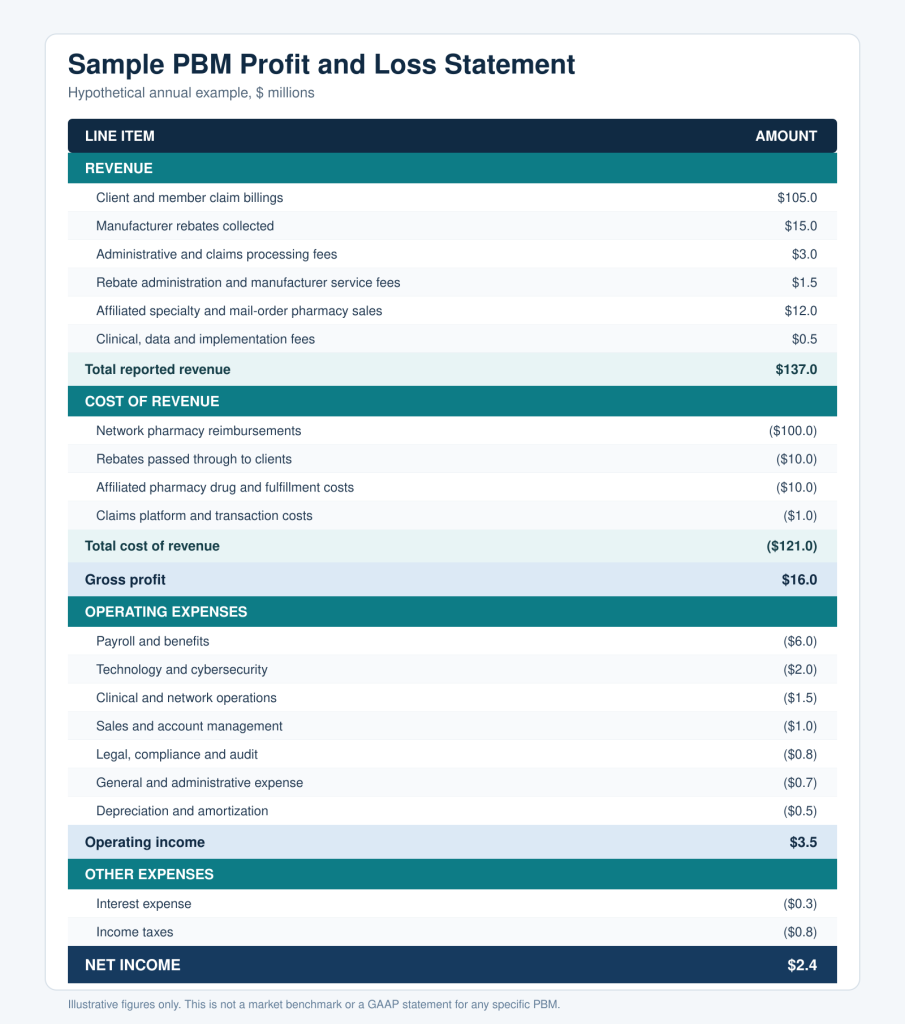
The reported net margin is 1.8 percent, calculated as $2.4 million divided by $137 million. That looks modest. Yet net retained compensation is $17 million after subtracting pharmacy reimbursement, rebate pass-through and affiliated pharmacy product costs. Net income divided by net retained compensation is 14.1 percent.
The second calculation is a management view rather than a substitute for GAAP. Its value is diagnostic. It shows why employers should not accept a headline margin as proof that compensation is reasonable.
What a plan sponsor should request
A plan sponsor should request three files for each reporting period:
- A claim-level paid claims file showing the amount billed to the plan and member, the amount paid to the pharmacy and all adjustments.
- A rebate remittance file showing gross rebates and fees received, amounts credited to the plan and payment dates.
- A compensation and affiliate schedule identifying each direct and indirect payment, recipient, related entity and shared expense allocation.
Reconcile these files to the PBM P&L and require audit rights covering subcontractors and affiliates. An “administrative fees” line is incomplete if the PBM also earns money through pricing differences or an affiliated pharmacy.
The purpose is to understand the arrangement’s economics. A fiduciary standard of care requires the employer and its advisers to identify all compensation, judge whether it is reasonable and confirm that the contract serves the plan and its members.