Self-funded employers spend months negotiating pharmacy benefit terms, reviewing clinical programs, and selecting a pharmacy benefit manager, only to lose control once claims start processing. The contract may look good. The pricing may look competitive. The clinical strategy may sound reasonable. But if members are routinely filling non-formulary drugs, the plan is bleeding money. A formulary is only as good as the discipline behind it.
That is why formulary compliance matters.
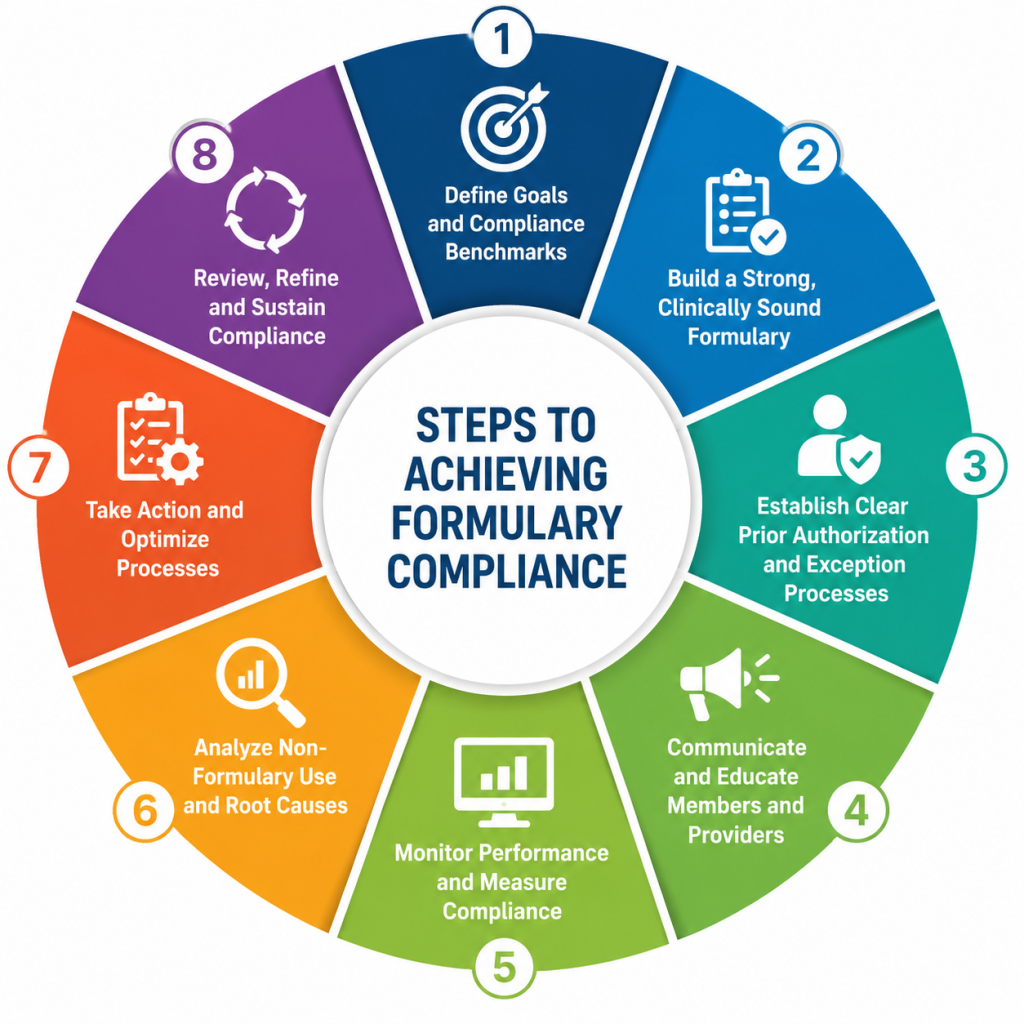
Formulary compliance measures whether the drugs being paid for by the plan align with the plan’s approved drug list. In plain English, it answers a simple question: Are we paying for the drugs we agreed should be covered, or are we paying for exceptions, workarounds, and waste? A practical way to measure formulary compliance is to calculate non-formulary spend as a percentage of total net drug spend:
Formulary Compliance Rate (measured by non-formulary spend %) = non-formulary drug spend ÷ total net drug spend × 100
For this benchmark to be useful, “total net drug spend” must be defined consistently. Start with total allowed pharmacy cost, then subtract all credits that reduce the plan’s true cost, including rebates, drug-level credits, refunds, guarantees, reversals, adjustments, and other post-adjudication pharmacy credits returned to the plan. Copay assistance credits should only be included if the plan actually captures those dollars. Without a clear net spend definition, the non-formulary spend percentage can make compliance look better or worse than it really is.
For example, if a self-funded employer spends $10 million annually on prescription drugs and $250,000 is tied to approved non-formulary claims, the plan’s non-formulary spend rate is 2.5%. In most cases, 2% to 3% or less suggests the formulary is being followed and exceptions are being used appropriately. A rate between 3% and 5% deserves review. Anything above 5% should trigger a deeper audit of exception approvals, therapeutic classes, and whether the PBM or pharmacy benefit administrator is allowing the P&T committee’s work to be bypassed.
This gives HR, finance, and benefits consultants a clean starting point. You can also track the number of non-formulary claims, the number of members using non-formulary medications, and the top therapeutic classes driving the spend. But the dollar impact should come first because that is what reveals whether the issue is material. A strong compliance report should show three things:
- Total formulary drug spend
- Total non-formulary drug spend
- The reason non-formulary claims were approved
Without the reason codes, the report is incomplete. Some exceptions are clinically appropriate. Others are just poor plan management. Good compliance does not mean zero exceptions. That is unrealistic and, in some cases, inappropriate. Good compliance means the plan has a clear formulary, a fair exception process, and a low level of non-formulary spend that can be explained.
Another example, suppose a self-funded employer spends $10 million annually on prescription drugs. If $350,000 is non-formulary spend, that may be acceptable if most of it is tied to documented clinical exceptions, failed step therapy, or continuity-of-care decisions. But if $1.5 million is going to non-formulary drugs with no clear documentation, no prior authorization history, and no therapeutic rationale, that is not member advocacy. That is plan leakage.
This is where the Pharmacy and Therapeutics committee, commonly called the P&T committee, becomes critical. A formulary should not be built by sales teams, rebate departments, account managers, or anyone else with a financial interest in which drugs win preferred placement. It should be built through a clinical review process led by qualified, conflict-free professionals who evaluate safety, efficacy, therapeutic value, and appropriate alternatives.
The most efficient way to measure formulary compliance is to monitor non-formulary spend as a percentage of total net drug spend.
When the P&T committee does its job well, the formulary has clinical credibility. It gives the plan sponsor a defensible basis for coverage decisions. It also helps separate legitimate clinical exceptions from financial manipulation. The problem starts when the work of the P&T committee is circumvented after the fact.
This can happen when non-formulary drugs are routinely approved without documented clinical justification, when rebate arrangements override clinical recommendations, or when “special handling” is used to keep certain high-cost drugs flowing through the plan. Once that happens, the formulary becomes a suggestion instead of a standard.
For self-funded employers, that is dangerous. The plan sponsor may believe it has adopted a clinically sound formulary, while the actual claims experience tells a different story. A fiduciary standard of care requires the employer to know whether the formulary is being followed, whether exceptions are properly documented, and whether financial conflicts are influencing coverage outcomes.
HR leaders often worry that stronger formulary controls will create disruption. That concern is valid. Employees do not want to hear that a drug they have been taking is no longer preferred. HR does not want angry calls, escalations, or disruption during open enrollment.
The answer is not to avoid formulary management. The answer is to manage change with care. Members should receive advance notice, clear alternatives, access to clinical support, and a reasonable exception pathway. Most disruption can be reduced when the process is communicated early and administered consistently.
The bigger problem is that some stakeholders use “access” as a shield against accountability. They argue that formularies restrict care, create red tape, or interfere with the doctor-patient relationship. Sometimes that criticism is sincere. Other times, it is coming from parties that benefit when formularies are loose, confusing, or rebate-driven.
There are three common types of formularies employers should understand.
- A value-based formulary prioritizes drugs based on clinical effectiveness and total net cost. This model is usually best aligned with fiduciary oversight because it asks whether the plan is paying for the right drug at the right cost for the right reason.
- A rebate-driven formulary gives preferred placement to drugs that produce favorable rebate economics. This may lower the apparent cost on paper, but it can also favor higher list price drugs and create conflicts between plan savings and PBM revenue.
- A hybrid formulary blends clinical value, net cost, access, and rebate considerations. This can work, but only if the employer has full transparency into the decision-making process and can verify whether preferred drugs are truly in the plan’s best interest.
My bottom line.
Use 2 percent to 3 percent of total net drug spend as the working benchmark for paid non-formulary spend, 3 percent to 5 percent as a watch zone, and anything above 5 percent as a trigger for immediate review. The public literature suggests many plans have far more leakage than that, especially when formularies are broad or rebate-driven.
Formulary compliance is not about denying care. It is about enforcing the plan’s clinical and financial intent. A self-funded employer that does not monitor non-formulary spend is not managing the pharmacy benefit. It is funding whatever the system allows through. That is not oversight. That is trust without verification, and in pharmacy benefits, that is expensive.
How We Can Work Together
Whether you’re a plan sponsor trying to get control of pharmacy spend, or a broker guiding clients through PBM decisions, education is the fastest way to improve outcomes. If you want a focused, high-value session your team can actually use, here are several ways we can work together.
Option 1: Get Certified
American College of Benefit Specialists (ACoBS) equips benefits professionals with practical knowledge across pharmacy, medical, retirement, and voluntary benefits. Organizations working with ACoBS-certified consultants gain better plan oversight, stronger vendor accountability, and more disciplined cost control. The certification signals a clear commitment to fiduciary guidance and protecting plan assets.
Option 2: Book a Webinar
A clean, educational session for employers, brokers, or TPAs. We’ll cover the most common PBM profit tactics, how to spot contract red flags, and what a fiduciary standard of care looks like in pharmacy benefits. Great for client education and thought leadership.
Option 3: Join the Virtual Roundtable
Bring your internal team (HR, Finance, and Benefits) or your broker group. I’ll lead a live discussion focused on PBM oversight, cost drivers, and what to ask your PBM right now. You’ll leave with a short action list you can use immediately.
Option 4: Get a Quote
Pharmacy benefits now rival medical spend for many plans. Yet most are still governed by contracts few have fully read and pricing models few can clearly explain. That is a fiduciary risk, not just a cost issue.
If you want lower spend, tighter oversight, and alignment you can defend in front of a board or audit committee, act with intent. Certify your team. Educate your clients. Pressure test your PBM.