During a recent finalist presentation a PBM consultant asked about our biosimilar strategy. I explained that our review includes drug monographs along with the product label and available clinical trial data. We assess which patients are appropriate candidates. Our Pharmacy and Therapeutics committee then determines whether the product belongs on the formulary. Among clinically appropriate options we look for the most cost effective drug therapy to avoid the hidden cost of biosimilar rebates.
The consultant followed up, “What about the rebates?” My response was straightforward. We’re not chasing rebates. Once our clinical review establishes which therapies are appropriate we prioritize the lowest cost at the point of sale with savings that reach the patient. A drug can look attractive on a rebate report while leaving an employee paying substantially more to fill the prescription.
FDA approved biosimilars have no clinically meaningful differences in safety and effectiveness from their reference products.¹ Our clinical review builds on that foundation to assess how each product fits the patients we serve. We then evaluate the financial impact on both the employer and the employee. The rebate amount alone cannot tell us which option delivers the best value.
The Biosimilars Council illustrates this problem through a comparison of Humira and two pricing options for its biosimilar Amjevita. One option carries a higher list price with a substantial rebate. The other offers a much lower list price without a rebate. The difference becomes clear when we separate what the plan pays from what the patient pays.²
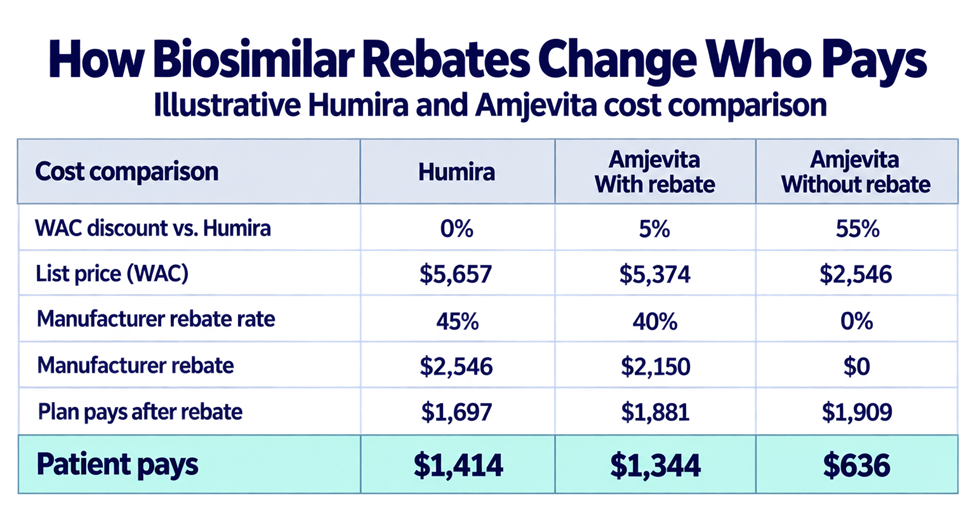
The rebated Amjevita option saves the plan $28 while the employee pays $708 more. An employer looking only at its own net expense might select that option. An HR leader looking at the employee’s experience has reason to challenge it. A modest reduction in the employer’s net cost does not justify a substantial increase in the employee’s cost.
That additional expense can become a barrier to treatment. Research on specialty medications has found that higher patient costs are associated with greater prescription abandonment.³ These are prescriptions that patients never pick up. Employers evaluating pharmacy savings need to consider whether employees can afford to begin and continue treatment.
The outcome depends on the benefit design. Fixed copays and manufacturer assistance can change the comparison. Deductibles and annual spending limits also affect what employees owe. Employers need an analysis using their actual benefits and claim prices that shows both patient costs at the pharmacy counter and plan costs after all rebates and fees.
Private label biosimilars add another financial relationship to examine. CVS Health owns Cordavis. Quallent operates within the same corporate family as Express Scripts. These businesses give the parent company a financial interest in products its PBM helps select for coverage. The FTC documented the largest PBMs’ expansion into private labeling and raised concerns about incentives to favor affiliated businesses.⁴
Formulary placement gives these arrangements their commercial power. CVS Caremark removed Humira from its major national commercial template formularies in April 2024 while expanding biosimilar coverage.⁵ CVS also markets a version of Hyrimoz through Cordavis.⁶ Express Scripts announced Humira exclusions on its largest commercial formularies for 2025 with alternatives that included products supplied through Quallent.⁷ These decisions can direct prescription volume toward products in which the PBM’s corporate family has a financial interest.
For an employer buyer the question is whether that preferred product offers the best available value. A substantial discount from Humira does not answer that question. A private label biosimilar can cost less than the reference drug and still cost more than another clinically appropriate option. The Amjevita example demonstrates why the comparison matters but does not establish the economics of any particular private label arrangement.
A 2025 employer case brings this purchasing decision into focus. Pharmacy Benefit Forensics reports that an employer coalition recommended a biosimilar from a PBM affiliated manufacturer while retaining rebates. The consultant identified alternative interchangeable biosimilars without rebates that it estimated would save the employer more than $8 million annually. According to the firm the employer changed its formulary and realized savings in 2025. The published account does not identify the employer or provide the underlying calculations or employee costs. It offers a relevant example of why employers need to evaluate alternatives even when a rebate appears attractive.⁸
The potential employer harm includes paying more than necessary and losing access to less expensive alternatives under the adopted formulary. Employers may also lack visibility into earnings retained by an affiliated distributor or specialty pharmacy. A rebate pass-through promise does not automatically reveal those earnings. Contract terms may further complicate the decision if selecting another product affects rebate guarantees or triggers other financial consequences.
My recommendation is to avoid private label arrangements tied to the PBM and preserve purchasing flexibility. Private labeling alone does not make a medicine clinically inferior or prove that it costs more. The concern is whether the organization recommending the product benefits from that selection in ways the employer cannot evaluate. Require disclosure of affiliated interests and a comparison against competing biosimilars before accepting the recommendation.
HR leaders and brokers can make these expectations part of the purchasing process. Ask for the plan and employee costs of each clinically appropriate alternative. Confirm the financial consequences of choosing a different product. Require support for patients during transitions and preserve clinically appropriate exceptions. After implementation track employee spending and prescription abandonment alongside plan costs.
The next time a biosimilar discussion turns to rebates bring it back to what the employer and employee actually pay. In the illustration above the plan saves $28 while the employee takes on another $708. That tradeoff deserves more scrutiny than a favorable line on a rebate report. An employer’s biosimilar strategy succeeds when the savings help employees afford their treatment.
Sources
- U.S. Food and Drug Administration. Overview for Health Care Professionals.
- Biosimilars Council. When Is a Smaller Discount Better? How Upside-Down Pharmaceutical Incentives Lock Patients Into High Costs. May 16, 2023.
- Journal of Managed Care Pharmacy. Association of Prescription Abandonment With Cost Share for High-Cost Specialty Pharmacy Medications. 2009.
- Federal Trade Commission. Pharmacy Benefit Managers: The Powerful Middlemen Inflating Drug Costs and Squeezing Main Street Pharmacies. Interim staff report. July 2024.
- CVS Health. CVS Caremark Accelerates Biosimilars Adoption Through Formulary Changes. January 3, 2024.
- CVS Health. Biosimilars. Overview of the Cordavis and CVS Caremark biosimilar strategy.
- Evernorth. Express Scripts Continues Efforts to Lower Drug Costs and Ensure Streamlined Patient Access. Announcement of formulary changes for 2025.
- Pharmacy Benefit Forensics. Robert Schenk. 2025 PBM Findings. Consultant account of employer savings opportunities and actions taken in 2025.