A recent RFP reminded me why pharmacy benefit procurement cannot be judged by spreadsheet pricing alone. After we submitted our proposal, we learned that some competing bidders were quoting brand retail 30 days discounts as high as 33% off AWP. At first glance, that may look attractive. But those discounts are well below WAC and would leave most pharmacies underwater on brand claims. The bigger issue was how the numbers were built.
Even though the RFP instructed bidders not to include embedded discounts, some appeared to fold other financial credits into the brand discount, making the headline number look stronger than the actual pharmacy reimbursement economics could support. In this context, an embedded discount means a credit, offset, rebate value, access fee, or other financial concession included inside a quoted discount instead of being disclosed as a separate line item. Employers, brokers, and consultants cannot rely on headline discounts. They must know what is included, what is excluded, and whether the pricing can actually work at the pharmacy counter. To the consultant’s credit, the following RFP was revised to prevent bidders from repeating the same tactic.
The first trap with PBM RFPs is that too many of them reward the best-looking spreadsheet, not the best deal. A bidder can make a proposal look aggressive by quoting eye-catching discounts, rebate guarantees, and low administrative fees. The employer sees a clean side-by-side comparison and assumes the lowest projected net cost is the winner. I have seen this mistake enough times to know better. A spreadsheet can compare numbers, but it cannot tell you whether those numbers are enforceable, whether the definitions are tight, or whether the bidder has left itself room to soften the offer once the contract is signed.
This is where many RFPs go sideways. They score proposals as if every bidder used the same assumptions and pricing logic. In pharmacy benefits, that is a dangerous assumption. A brand discount can be watered down by drug reclassification. A rebate guarantee can shrink once exclusions are applied. A low admin fee can become much less impressive if other revenue streams sit outside the pricing exhibit. The issue is not that spreadsheets are useless. They are necessary. But they should start the diligence process, not end it.
The second trap is that many RFPs give bidders too much room to maneuver. That sounds like a small process issue, but it can change the outcome. If the RFP says not to include embedded discounts, then the response should not include embedded discounts. If the RFP asks for pass-through pricing, the bidder should explain what is passed through, when it is passed through, and how the employer can verify it. If the RFP asks for a rebate guarantee, the bidder should not be allowed to hide behind broad language, selective exclusions, or definitions that only become clear after finalist selection.
This is where a good consultant earns their fee. The RFP has to force every bidder onto the same playing field. Not roughly the same. The same. That means the pricing assumptions need to be certified. Exclusions need to be disclosed plainly. Definitions need to be nailed down before scoring, not negotiated after the winner is chosen. If a bidder includes credits, access fees, purchasing economics, manufacturer revenue, or any other pricing input that was not requested, they should have to identify it and show how it affects the projected cost. If they do not comply, the response should be adjusted, challenged, or disqualified. Otherwise, the process rewards the bidder willing to bend the rules and penalizes the bidder who followed them.
The third trap is that many PBM RFPs stop at vendor selection instead of building accountability after implementation. This is one of the most common failures I see. A proposal may include strong pricing guarantees, clean disruption reports, and polished service commitments, but the employer still needs a way to verify performance once claims start processing. Without claim-level reporting, audit access, rebate reconciliation detail, service guarantees, implementation milestones, and real consequences for missed commitments, the employer is relying on trust where oversight is required.
That is where fiduciary procurement separates itself from ordinary procurement. The goal is not just to pick a PBM or pharmacy benefit administrator. The goal is to create a structure for monitoring the plan after the award is made. Did the network perform as represented? Were rebates collected and passed through according to the agreed terms? Were claims adjudicated using the promised pricing? Were exclusions applied properly? Were members disrupted beyond what the proposal suggested? These are not academic questions. They are the questions that determine whether the employer got the deal it thought it bought.
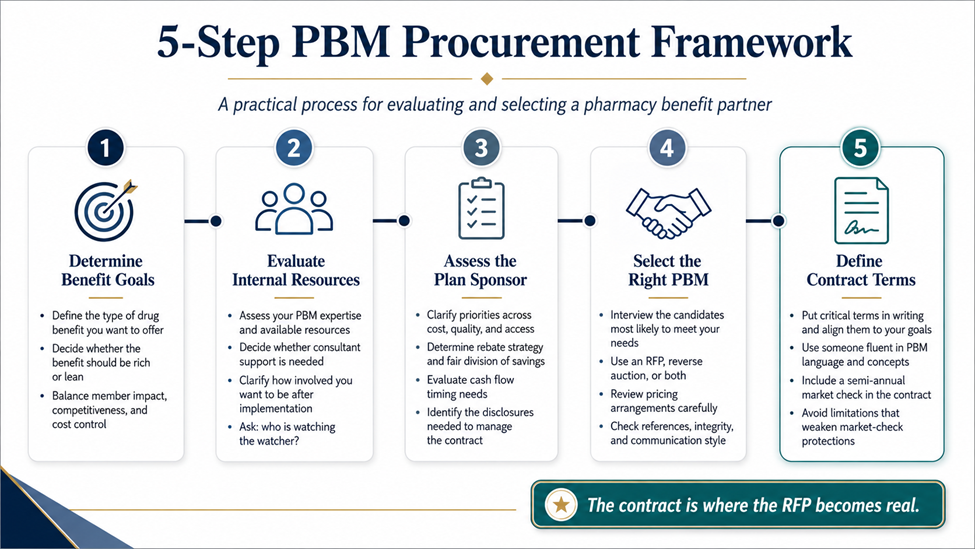
Drafting, negotiating, and finalizing a contract with a PBM are the three most important tasks during an RFP. The proposal may get a bidder to the table, but the contract determines whether the employer can enforce what was promised. Too many plan sponsors treat contracting as an administrative step after vendor selection. That is backwards. The contract is where the RFP becomes real. If the pricing, definitions, guarantees, audit rights, reporting obligations, and fiduciary expectations do not make it into the contract, they are little more than sales language.
The strongest RFPs force bidders to prove three things. The pricing must be verifiable. The contract must be enforceable. The model must be accountable after go-live. That requires clear attestations, tight definitions, full disclosure of exclusions, audit rights, reconciliation rules, service guarantees, and consequences for non-compliant responses. More importantly, it requires a mindset shift. The RFP is not just a purchasing document. It is the first draft of the oversight framework.
My view is simple. If a PBM’s offer depends on vague definitions, selective exclusions, nonstandard pricing inputs, or assumptions that cannot be explained plainly, that is not a strong bid. It is a warning sign. A fiduciary procurement process does not chase the lowest bid. It selects the most verifiable, enforceable, and accountable bid. That is the difference between buying a spreadsheet and overseeing a pharmacy benefit plan.