Tip of the Week: Money is good, Information is better [rerun]

Three economists were critical in creating and expounding on the hypothesis of information asymmetry or information failure: George Akerlof, Michael Spence, and Joseph Stiglitz. The three shared the Nobel Prize in economics in 2001 for their commitments. 

Information Asymmetry hypothesis suggests that sellers may have more data than purchasers, slanting the cost of merchandise sold or services rendered. The theory argues that low-quality and high-quality services can command the same price, given a lack of information on the buyer’s side. 

Akerlof initially contended about information asymmetry in a 1970 paper named “The Market for ‘Lemons’: Quality Uncertainty and the Market Mechanism.” In this paper, Akerlof gave a new explanation for a well-known phenomenon: the fact that cars barely a few months old sell for well below their new-car price. Akerlof’s model was simple but powerful. 
Assume that some cars are “lemons” and some are high quality. If buyers could tell which cars are lemons and which are not, there would be two separate markets: a market for lemons and a market for high-quality cars. But there is often asymmetric information: buyers cannot tell which cars are lemons, but, of course, sellers know. Therefore, a buyer knows that there is some probability that the car he buys will be a lemon and is willing to pay less than he would pay if he were certain that he was buying a high-quality car. This lower price for all used cars discourages sellers of high-quality cars. 
Although some would be willing to sell their own cars at the price that buyers of high-quality used cars would be willing to pay, they are not willing to sell at the lower price that reflects the risk that the buyer may end up with a lemon. Thus, exchanges that could benefit both buyer and seller fail to take place and efficiency is lost.
KEY TAKEAWAYS
PBMs know exactly how much they are charging (management fee) for their services, but self-funded employers do not. Non-fiduciary PBMs don’t want buyers (employers) to know how much revenue they generate because it would allow better decisions on the part of their customers. Those customers, self-funded employers among others, don’t realize that in many cases the PBM’s management fee contributes more to their final plan costs than does the ingredient cost
A large number of the difficulties self-funded employers face come about because of something they are doing or not doing, something that changing broker, benefits consultant or even PBM won’t fix. My experience reveals that their grievances about prescription drug prices and pharmacy benefits management in general stem from the self-funded employer’s choices and constraints, not a lack of options.
Self-funded employers are smart but they are unaware of or lacking information that might benefit them in improving their pharmacy benefit management decisions. Better decisions are the first step to improving their employer-sponsored pharmacy benefits results. The key then to getting to lowest net cost and maximizing efficiency in their pharmacy benefit program is eliminating information asymmetry which requires extensive pharmacy benefits management education and training.

AIDS Healthcare Foundation Taking Tough Stance on PBMs – Pharmacy Benefit Manipulators, Really?

In response to growing consolidation and increasingly monopolistic behavior in the pharmacy and health care industries, AIDS Healthcare Foundation (AHF) is launching a new advocacy campaign to take on pharmacy benefit managers (PBMs) that are undercutting community pharmacies and driving up drug prices.

The national campaign aims to raise awareness about PBMs’ undue influence on patients’ access to the prescription drugs they may need and to educate the public and press elected officials to call out and prevent PBM abuses. The campaign also hopes to rein in the abusive industry, which broadly functions as middlemen between insurance companies and pharmacies.

AHF’s ‘Stop PBMs’ campaign will include direct and online community mobilization, legislative outreach, online and print advertising, a website, social media posts and more, all urging greater regulation of these corporate health care middlemen that are driving up drug prices. According to AHF, Ryan White contract pharmacies & independently owned pharmacies are being hurt by PBMs in several ways:

(1) PBMs often enforce mandatory mail order of prescription drugs by their patients/clients, and

(2) Force expensive drugs onto patients

(3) Send six months’ worth of medications that may, or will expire

(4) Send refrigerated medications that will go bad sitting on doorsteps

(5) Force pharmacies into accepting reimbursement that doesn’t cover their costs through take it or leave it contracts and abusive practices like clawing back reimbursements months or years after payment.

Tyrone’s Commentary:

If you’ve read any of my previous blog posts you know that I give non-fiduciary PBMs no slack. I just personally believe it is better to do a lot of good and make less money then to make a lot of money and do harm. That being said, most of what AHF is purporting is spot on but one thing bothers me. The finger always gets pointed at the PBM. Plan sponsors rarely take responsibility for their role in how the pharmacy benefit is managed or what it ultimately costs. No one ever says, “You know we really suck at managing our pharmacy benefit no wonder our PBM takes us to the cleaners. Maybe we should get smarter about how to manage the darn thing.” PBMs generally rely on the demands of their clients for how much information they disclose and how close you get to lowest net cost. If you are overpaying, it is likely your own fault. The non-fiduciary PBM is simply leveraging the purchasing power of its unsophisticated clientele. 

<<Continue Reading>>

Tuesday Tip of the Week: PBM’s are the Only Check on Drug Manufacturers’ Ability to Increase Drug Costs

PBMs are a critical component of the health care supply chain. The veiled reason groups want PBMs removed from the picture is because they want a bigger slice of the pie. PBM’s are the only check on drug manufacturers’ ability to increase the cost of drugs by negotiating the price to reasonable rates and avoiding cost hikes, as there is currently no regulation over Big Pharma and the prices they set. How do PBMs help plan sponsors save money?

1) Negotiate discounts

2) Increase use of generics
3) Make distribution more efficient
4) Negotiate rebates
5) Formulary management
6) Plan design
While PBMs are a critical component of the health care supply chain, they are also adding too much costs to the supply chain. Both can be true, we are critical components and charge too much. PBMs do a great job at negotiating savings but get greedy when the time comes to return those savings back to plan sponsors. Education is the key to getting to lowest net cost in pharmacy benefit plans. 
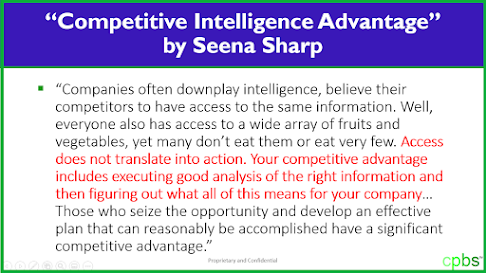
Only the most sophisticated purchasers of PBM services will have the knowledge and confidence to bind radical transparency into PBM contract language and benefit design. Hence, your competitive advantage includes executing good analysis of the correct information then deciding what all of this suggests for your organization. Those who seize the chance and develop a good plan, that may reasonably be accomplished, have a higher probability of getting to lowest net cost.
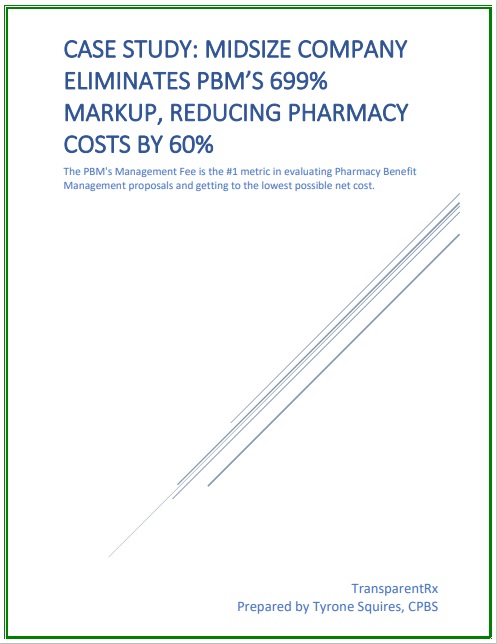
CASE STUDY

After going through a market check in 2019, a midsize client was looking for a better deal than their incumbent PBM. The client hired a major consultant to evaluate offers from leading PBMs to determine who would provide the best deal. Despite ranking middle of the pack on the consultant’s scorecard, TransparentRx won the business. We were able to demonstrate how transparency and the PBM’s management fee impacts cost. 
When the carrier, PBM and ASO all share the same parent company, it may combine aspects of the two funding options to subsidize pricing by cost-shifting. Self-insured employers may have forces working against them. Here are the results after the first twelve months:

Ninety-Two Percent of Self-Insured Companies Lack a Formalized Pharmacy Benefits Management Process

Image result for no plan
Click Here To Get Your Plan

This one is the proverbial head-scratcher. Nine out of ten self-insured companies do not have a formalized pharmacy benefits management process. The results from our phone poll were startling, to say the least. During Q1-Q3 2018, I asked the TransparentRx sales staff to pose a question to small, medium and large self-insured employers.

In the qualification stage of our sales process, we asked employers, “do you have a written plan to procure, monitor and evaluate your pharmacy benefits management service?” Of the 1017 self-insured employers who responded, here is what they shared with us.

For the process to be considered “formalized” each employer had to have a written plan. If the employer did not have a written plan we considered them not to have a formalized process. We could’ve easily stopped there as 81% of employers did not have a written plan.

Additionally, employers who professed to have a written plan (19% or 193 employers) were asked if their plan addressed the following seven sub-criteria:

1) Defined Team Roles
2) Reasonable Goals
3) Clear Objectives
4) Dispute Resolution Process
5) Monthly Performance Reviews with the PBM’s Account Manager
6) Quarterly Meetings with the PBM’s Executive Sponsor
7) Recurrent Training of In-House Staff who Oversee Pharmacy Benefits

If they answered no (11% or 112 employers) to three or more of the sub-criteria we found them not to have a formalized pharmacy benefits management process. Because the three primary criteria (procurement, continuous monitoring and evaluation) are not mutually exclusive to overall performance, an employer who did not address each process on its own merits was considered not to have a formalized process.

In summary, 936 out of the 1017 employers we polled did not have a formalized pharmacy benefits management process. This may come as a surprise to my readers but not to me. For me, it’s just disappointing but why is it important? As I conclude this post I’m reminded of a quote from arguably the greatest business mind of our time.

“Ideas are worth nothing unless executed. They are just a multiplier. Execution is worth millions.” ? Steve Jobs