Copayment coupons are adding to pharmacy costs [Tip of the Week]

According to a study published by the National Bureau of Economic Research, drug copay coupons offer patients savings on prescriptions, but they significantly increase amounts paid by insurers and employers. Three economists analyzed data on net-of-rebate prices and quantities from a large pharmacy benefits manager. They found drug copay coupons increased quantities sold by 21-23 percent for the commercial segment relative to Medicare Advantage in the year after they were introduced, but they do not affect net-of-rebate prices.

The research team estimated coupons raise negotiated prices by 8 percent and result in about $1 billion in increased U.S. healthcare spending annually — just for multiple sclerosis drugs. Combined, the results suggest copayment coupons increase spending on couponed drugs without bioequivalent generics by up to 30 percent. A disturbing trend is patients aren’t required to present copayment coupons at the point of sale. In fact, many patients believe the plan is providing a discount. 

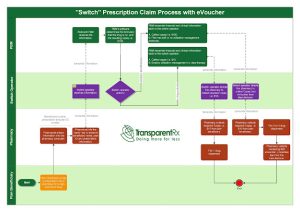
Brand drugmakers circumvent pharmacy benefit plan designs by offering eVouchers or electronic vouchers for expensive drugs at the “Switch.” The switch is what routes the third-party prescription claims to the PBM, or health plan associated with the prescription. Within seconds, the script leaves the pharmacy, goes to the switch, and then is received at the relevant PBM.

When the benefit design has soft UM or no utilization management protocols, such as mandatory generic enforcement, it allows drugmakers to bypass a tier 1 drug for a tier 2-4 drug or even worse a non-formulary drug, with eVouchers (see process flow diagram below). The two largest switch companies are RelayHealth and Change Healthcare

As Relay Health tells the story, its electronic voucher program is a Win-Win-Win solution. Doctors set aside concerns over costs, patients benefit from lower copays and increased adherence, and manufacturers benefit from the likelihood patients will fill and adhere to the drugs thereby increasing brand loyalty.

But what about you, the health plan sponsor? You are conveniently left out of the equation even though you cover most of the cost. I teach in our CPBS Certification course how plan sponsors fund the entire USA prescription drug system but know the least about how it works. Simply put, it is your checkbook they are after. The fiscal impact of switch operators’ eVoucher programs to health plan sponsors is significant and growing with each passing day.

There are two ways to prevent the scenario above from happening:

(1) PBM puts language into its contract with the Switch company, preventing the action.
(2) Benefit design maximizes the drug utilization management toolkit including prior authorization, step therapy and mandatory generic enforcement programs.

The first bullet point, PBM puts language into its contract, is unlikely to happen. Some PBMs want in on the action. Number two is sticky as many plan sponsors are hellbent on employees getting the drug they want without any scrutiny (i.e. step therapy). I don’t agree but it’s not my checkbook. 


Pharmacy benefits management should make people happy through better outcomes so not to avoid the pain that comes with running an efficient pharmacy benefit program. In a sense, drugmakers, and non-fiduciary PBMs for that matter, are leveraging HR’s desire to keep employees “happy” at the expense of efficiency.

eVouchers, especially when supported with direct-to-consumer TV ads for high-cost brand drugs and soft utilization management protocols, are an expensive proposition for health plan sponsors yet lucrative one for brand drugmakers.

Every Health Care Plan Sponsor Must Have a System in Place to Make Sure Drugs Work [Tip of the Week]

There are three things I believe every health care plan sponsor should have in place (1) system to make sure members are taking the prescribed drugs (2) system to make sure the prescribed drugs work (3) system to make sure the prescribed drug is going to the right patient. As drugs get more expensive and complex so to must the services PBMs offer to keep pace. Watch the short video (1:30) to see what the Pharmacy and PBM Leader at Deloitte Consulting has to say about achieving optimal clinical and cost outcomes with specialty drugs.

Click to Watch

What is the Certified Pharmacy Benefits Specialist (CPBS®) training program designed for?

This educational offering includes knowledge that is critical to effective management of the pharmacy benefit. Each class concludes with a knowledge assessment test to help gauge student comprehension. Students are required to pass a comprehensive final exam with a score of 85% or better to qualify for the CPBS designation.

Employee Benefits 

  • Enhance your candidacy – one out of two hiring managers prefer job applicants with a certification 
  • Stay competitive in the workforce and raise your professional value 
  • Network with other employee benefits professionals
  • No or low out-of-pocket costs; employer may pick up portion of the costs 

Employer Benefits

  • Certified employees drive business goals through increased self-motivation and confidence
  • Uphold or gain competitive advantage in the marketplace because of the PBM mastery held by human capital 
  • Internal career advancement for certified staff which reduces hiring and onboarding costs 
  • Clients have more confidence in the results of certified staff
Pharmacy Benefit Managers will provide transparency and disclosure to a level demanded by the competitive market and generally rely on the demands of prospective clients for disclosure in negotiating their contracts. The best proponent of transparency is informed and sophisticated purchasers of PBM services. 

The purchaser needs to understand not only what they want to achieve in their relationship with their PBM but also the competitive market and their ability to drive disclosure of details on services important to them. Achieving optimal outcomes, cost and clinical, will be more effectively done by a trained eye with personal knowledge of the purchaser’s benefit and disclosure goals.

4 Little Known Ways to Optimize Drug Spend [Tip of the Week]

Managing drug spend efficiently is no easy task. It requires quite a bit of time, effort, and skill to do it right. Anyone with business training can look at a P&L statement and determine whether a company made a profit. However, understanding the story behind the numbers requires a certain set of skills only a certified public accountant can provide, for example. The same can be said for medical and pharmacy benefit drug costs.

Pick anyone from HR, finance or procurement and they will tell you succinctly that prescription drugs are expensive. Ask these same professionals how to reduce costs without increasing employee cost share, restricting access, or trimming benefits and you’ll get crickets. You’re thinking, that’s why we hire brokers and consultants. I’ll let the note Michael Critelli, former CEO at Pitney Bowes, sent to me address that point.

“I am pleased that you wrote the particular essay I downloaded. Many corporate benefits departments do not understand that they are overmatched in negotiating with pharmacy benefit managers, as are the “independent consultants” who routinely advise them. The first step in being wise and insightful is admitting what we do not know, and you have humbled anyone who touches this field.”

For those interested in improving their company’s medical and pharmacy benefit drug cost performance and unafraid of unconventional concepts, here are 4 Little Known Ways to Optimize Drug Spend.

1) Dr. Sree Chaguturu, the chief medical officer for CVS Caremark, recently made this bold recommendation, “Combine coverage for all specialty medications—including those currently covered in the medical benefit—under the pharmacy benefit.” Regardless of the motivation behind the recommendation, Dr. Chaguturu is correct. There are some distinct advantages beyond the obvious potential for realizing lowest net cost. PBMs use utilization management (UM) programs to encourage the use of generics or preferred products, for example. UM is the unsung hero of an efficiently run pharmacy benefits management program. These programs are extremely limited in medical benefits which leads to Fraud, Waste, and Abuse.
2) Put the contract front and center during your next RFP (request for proposal).

3) Move beyond simple spreadsheet analysis. When conducting a side-by-side claims analysis it is a disservice to plan sponsors when “best price” is calculated from a claim repricing report. Instead, the data must be viewed holistically. Ask yourself, “if the plan were being managed efficiently, what would the final plan cost for this group have been?” A claims analysis or re-pricing looks primarily at retrospective pricing which is a good starting point but does not come close to telling the whole story. For example, it doesn’t usually consider poor product mix or bad utilization from which non-fiduciary PBMs intentionally profit. It’s not unusual for a legacy PBM’s management fee to be higher than your drug costs at the end of a plan year. This management fee is profit which is hidden in the final plan cost. Any cost analysis which doesn’t take into consideration the PBM’s management fee falls well short of telling the entire story.

4) Get PBM educated. “The illiterate of the 21st century will not be those who cannot read and write, but those who cannot learn, unlearn, and relearn,” wrote Alvin Toffler. Education is the most logical and effective foundation for achieving extraordinary results in pharmacy benefit management services. To improve on the job execution and career growth, benefits consultants, finance managers, procurement and HR professionals must expand their PBM knowledge beyond a functional role and understand exactly how each domain works together within the pharmacy distribution and reimbursement system. Don’t operate an inefficient employer-sponsored pharmacy benefit program. Learn the intricacies of managing pharmacy benefits like a pro.

Tip of the Week: Three Undervalued PBM Performance Metrics

Education has always been the key to reducing skyrocketing health care costs. So I, for one, am not disappointed by the fact Congress did not include provisions to eliminate PBM self-dealing within Medicaid managed care and Medicare Part D programs. Worse yet, commercial plan sponsors were left to themselves to deal with excessive PBM hidden cash flows without any help from the Build Back Better Act. Employers must step up and fight their own battles with the pharmaceutical manufacturers, consultants, and pharmacy benefit managers. The harsh reality is many purchasers of PBM services, and their advisors, don’t want lower drug prices if it has to come at the expense of their own profits or quality of life. Let that sink in for a moment. Here are three of the most undervalued PBM performance metrics.

1) Generic Substitution Rate or GSR is the rate at which generic drugs are dispensed in place of their brand equivalents. A 2020 analysis from Avalere Health finds 52% of Medicare Part D plans achieve generic substitution rates above 75%. In commercial plans, I would assume that number to be lower. Is there anyone, with an ownership mindset, and a hand on the big red button to say no? I can tell you that TransparentRx’s book GSR is above 98%. We are relentless in our pursuit to eliminate wasteful spending. For example, Semglee has been on our national preferred formulary for more than one year. We will remove Semglee for 2022 and replace it with unbranded Insulin Glargine. For any health plan sponsor to have a GSR below 75%, is textbook fraud, waste, and abuse. 

2) Generic Dispense Rate or GDR means the percentage of all prescription drug fills that were for generics. In 2017, GDR for Medicare Part D was reported to be 82.2%. Like GSR, the GDR should be at or above 90%. Excluding Covid-19 vaccines, TransparentRx’s book is slightly above a 90% GDR. If you include Covid-19 vaccines, we are at 86% and change through 9/30. An 80% GDR, excluding for Covid-19 vaccines, is not good. In fact, it is poor. There is no excuse for it. Prescription drug cost savings are realized with increases in GDR without any downgrade in outcomes. Each 1 percentage point increase in GDR is associated with a drop of up to 2.5% in gross pharmacy expenditures. When 90% or more of your claims are for generics, half the battle for lowest net cost is won. 

Click to Learn More

3) Earnings After Cash Disbursements or EACD is what prompted the state of Ohio to terminate two PBM contracts when it uncovered close to $250,000,000 in hidden cash flows from just two PBMs in a single year. Ohio pivoted from evaluating PBM cost performance on discount guarantees and rebates to the PBM’s management fee. EACD or the PBM management fee is the amount of money a PBM is being paid to provide its services. It is only after you know how much money a PBM is taking home that you begin to realize the magnitude of overpayments. Running an efficient pharmacy benefits program requires understanding and applying EACD in your RFPs. The PBM must be willing to disclose both the source of its cash flows and the amount. If it balks, just walk away.

Twenty-years experience in HR, finance or as a broker will only get you in more trouble unless you’ve had extensive and formal PBM training from an insider. Even with formal training the road to radical transparency can still be tough. Brokers and consultants must balance the needs of their clients with those of the organization and themselves personally, for example. It is worth repeating, education has always been the key to eliminating hidden cash flows to non-fiduciary PBMs thus delivering more value through better outcomes.

In conclusion, there is enough blame to go around for all stakeholders including PBMs. Without high pharmacy benefits management acumen and strong negotiating skills, you stand little chance of eliminating overpayments to a non-fiduciary PBM. It requires supreme confidence and moxy to stay true to your convictions. That confidence stems from PBM education. Non-fiduciary PBM salespeople have been trained to push you off your spot. That’s difficult to do when you know your stuff.

Tuesday Tip of the Week: 8 Considerations During Annual PBM Reviews

The primary reason an organization retains a PBM is to contain its pharmacy costs. PBMs do this in a variety of  ways, including negotiating pharmacy discounts, pharmaceutical manufacturer contracting, drug utilization management and automating administrative services. Because PBMs offer varying degrees of transparency, some contain costs better than others. Here are eight considerations during an annual PBM review.

1. Network tightening, including removing a single large chain, can result in more aggressive savings on ingredient costs without any loss in access. The type of network a PBM is running (i.e. acquisition cost, pass-through etc.) is less important than knowing what exactly the pharmacy is being reimbursed. The difference between what a plan sponsor is billed for ingredient costs and the amount a PBM reimburses a pharmacy for the same claim is called the spread.

2. The best way for a plan sponsor to determine if they are paying a spread is to know what the pharmacy is being reimbursed for that same claim at the NDC level. The 835 Health Care Claim Payment and Remittance Advice is the tool you need for disclosure of this information and ultimately getting to lowest net cost. Two basic sources of information are needed to permit an audit of the spread on a series of prescription transactions: (1) employers’ line-item Rx transaction invoices received from PBMs each month and (2) dispensing pharmacies’ itemized list of Rx transactions received with PBMs monthly payments. Generic discounts are often priced in one of two ways: as an AWP discount or at Maximum Allowable Cost (MAC). A large price gap usually exists between these two pricing elements.

3. Does the PBM offer any programs to help offset the cost or manage specialty drugs that are paid on the medical benefit? Site of care optimization simply means having a strategy to seek out and promote the most economical and clinically effective place to deliver care for a particular patient. While this may prove bothersome to some patients and third party administrators, you can’t have it both ways. Whomever covers the largest share of the drug cost should have the most say in the locations from which these very expensive drugs are dispensed. I don’t walk into my friends’ homes go into the refrigerator and put my feet on their sofas. You know why? I don’t pay their mortgages. Site of care management is good for self-funded employers. Since you cover most of the drug costs, its only right you have the final say so in where high cost drugs are dispensed.

Source:  Evernorth 2020 Drug Trend Report

4. COVID-19 may have depressed your overall utilization. Health insurance carriers have reported in their earnings calls that utilization of outpatient care was down significantly for much of 2020. New starts for prescriptions were also down. Find out your plan’s utilization patterns and if you should expect an increase as states reopen.

5. Programs that utilize manufacturer copay coupons to offset specialty medication costs are gaining in popularity. For plan participants, these programs typically set a zero-dollar cost share for qualifying specialty medications. For plan sponsors, these programs may save up to 20%-25% of specialty spend.

6.  Tweak your formulary with little to no member disruption. A formulary is a list of drugs favored by the PBM for their clinical effectiveness and cost savings. Manufacturers of specialty and branded drugs often promise financial incentives to have their drugs featured on the formulary. Drug formularies can be open, incented, closed or hybrid. There are five factors necessary for the makings of a good formulary. These factors include multiple enforcement mechanisms, a minimum five-tiered list of drugs, understanding of how the drugs are assessed, a firm dispute resolution process and an expedited appeal process. Each PBM has varying degrees of flexibility when it comes to formularies. A change may lead to lower net costs. 

7. Human immunodeficiency virus (HIV) medications have recently become a hot topic in the pharmacy space. Per the Affordable Care Act (ACA), employer-sponsored health plans are required to cover the HIV specialty drugs Pruvada and Descovy at 100% beginning their first plan year following June 19, 2020. The requirement follows a United States Preventive Services Task Force (USPSTF) recommendation that health plans cover pre-exposure prophylaxis (PrEP) with effective antiretroviral therapy to persons who are at high risk of HIV acquisition. Across our book of business, we saw an increase in the usage of these medications. This caused the HIV class to jump up for many employers’ top therapeutic classes. Plans should budget for this trend to continue. 

8. A 2020 drug trend report concluded specialty drug spending outweighed traditional drug spending for the first time ever. Commercial employers must engage all stakeholders and develop a pharmacy benefits management strategy which centers around high-cost ($15,000 or more per year) drug therapies. It goes without saying, any effort by a non-fiduciary PBM to protect its profit margins will start and end with specialty drugs. Understand PMPM by comparing your YOY trend and how it compares to relevant benchmarks. Put trend in context as percentages can be misleading.

There are two things which should be non-starters for purchasers of PBM services. One, having full access to your own claims data free of charge. Second, knowing what you pay a PBM for the services it was hired to perform. Your PBMs management fee is hidden in the plan’s final cost. Alvin Toffler wrote, “The illiterate of the 21st century will not be those who cannot read and write, but those who cannot learn, unlearn, and relearn.” Education is the most logical and effective foundation for achieving extraordinary levels of efficiency in a pharmacy benefit program.
Tuesday Tip of the Week: 3 Ways to Prepare for the Inevitable Rise in Pharmacy Benefit Costs

While the full impacts are yet to be resolved, specialists are foreseeing that the coronavirus will have an enduring, incessant effect on survivors. As per a Willis Towers Watson examination, in addition to health concerns, these people also face monetary concerns: medical and prescription drug costs for individuals with COVID-19 could spand $250 to $100,000.

An ongoing report by the Integrated Benefits Institute (IBI) additionally found that the complete expense of COVID-19 to employee benefit plans could surpass $23B, excluding auxiliary costs, for example, paid family leave time. This is notwithstanding other health insurance bills businesses were at that point confronting prior this year. Nonetheless, it is conceivable to lessen the expense of pharmacy benefits without increasing employee cost share or reducing benefit levels.
Carve-Out the Pharmacy Benefit
 
PBM programs typically function in two ways. They are either “carved in”, provided by the health insurance company or “carved out”, provided independent of insurance. Whether the pharmacy benefit plan is self-funded or fully insured, any employer with more than 100 active employees should consider and investigate a carve-out strategy for their pharmacy benefits.
A carved out program provides better cost control and transparency, technology and services, as well as information and reporting. Health insurers may bundle the two programs and subsidize some of the pricing from one service with that of another.
For companies with a carved in program, there may be concerns about changing to a carved out program due to a perception that additional time and resources will be needed, but I have seen that on a day to day basis, there is little difference in having a separate PBM program. The functions are the same. Forgoing retail pharmacy rebates for admin fee credits on the medical side is another non-fiduciary pricing game. With opaque contract language and subsequent hidden cash flows, the PBM and/or carrier will recoup those credits you thought were going to reduce costs.
Among the advantages of a carve-out are the following:
1.  Better Contract Terms

2.  Carved-out Specialty Rx 
3.  Customized Clinical Programs 
4.  Lower Pharmacy Costs
5.  Better Data Rights 
6.  More Detailed Analytics
7.  More Transparency 
 
As you can clearly see, there are significant advantages to pursuing a carve-out strategy, both for the plan sponsor and plan participants. PBMs will generally provide transparency and disclosure to a level demanded by the competitive market and rely on the demands of clients in negotiating their contracts. The best proponent of radical transparency or lowest net Rx cost is informed and sophisticated purchasers of PBM services.
Make a Good Formulary
 
A formulary is a list of drugs favored by the PBM for their clinical effectiveness and cost savings. Pharmaceutical manufacturers of specialty and branded drugs often promise financial incentives to have their drugs featured on the formulary. Drug formularies can be open, incented, closed or hybrids. There are five factors necessary for the makings of a good formulary. These include:
1. Multiple enforcement mechanisms
2. A minimum 5 tiered list of drugs
3. Understanding how the drugs are assessed
4. A firm dispute resolution process
5. An expedited appeal process
An enforcement mechanism is particularly important. Certain drugs require prior authorization before they are covered under the drug benefit. Prior authorization is the pre-approval of a drug by the PBM before a pharmacy can dispense it. Not all enforcement mechanisms are created equally. Just because your PBM employs these tools doesn’t mean they are being maximized or effective. Be sure to put in place criteria to measure the PBMs execution of enforcement mechanisms.
Do Business with a Fiduciary PBM
 
Approximately one year ago, Ohio’s Attorney General announced a four-part proposal calling for quick action from the state’s legislature to shine a bright light on PBM contracts. The goal was to cut down on the hidden cash flows to non-fiduciary PBMs. AG Yost’s proposal called for:
  • Drug purchases in the state to be conducted under a master PBM contract that is administered by a single contact point
  • Ohio’s Auditor of State to have full power to review all PBM contracts, purchases and payments
  • The state to prohibit nondisclosure agreements on drug pricing.
  • PBMs to operate as fiduciaries, uh-oh!
So, what is the difference between a fiduciary PBM and one that isn’t? There are some very big differences.
  1. Fiduciary PBMs must provide full disclosure
  2. Fiduciary PBMs provide more transparency
  3. Fiduciary PBMs are a better value (ex. less reliance on PBM consultants or other vendors to reduce drug costs)
  4. Final plan costs can be significantly lower with Fiduciary PBMs due to elimination of hidden fees and maximization of clinical programs including formulary management
In a fiduciary relationship, one person, in a position of vulnerability, justifiably vests confidence, good faith, reliance and trust in another whose aid, advice or protection is sought in some matter. In such a relationship, good conscience requires the fiduciary to act at all times for the sole and interest of the one who trusts.
A fiduciary ideally would not have a conflict of interest. It has been said that fiduciaries must conduct themselves “at a level higher than that trodden by the crowd” and that “[t]he distinguishing or overriding duty of a fiduciary is the obligation of undivided loyalty.
Pharmacy Benefit Managers whose business models are predicated on hidden cash flows will be very reluctant to provide full disclosure. A leopard cannot change its spots. However, plan sponsors who are relentless in their pursuit of radical transparency can significantly reduce pharmacy spend without sacrificing benefit levels or asking employees to pay more by doing business with a fiduciary-model PBM.

Tuesday Tip of the Week: Price Isn’t the Only Driver of Pharmacy Costs

Many PBM selection decisions come down to two things: comfort and price. Provided employers have done their due diligence, an employer’s comfort level with a PBM or its owner should take a back seat to the best candidate. Because PBM services have been commoditized, the best candidate should boil down to who delivers the lowest net cost. 

 
Gasoline is a commodity. The gasoline at Speedway is largely the same as that pumped at Shell. You aren’t going to get better gas mileage or a cleaner engine buying gasoline at Shell but you will pay more. Hence, the claim being adjudicated by TransparentRx is the same as that at Optum, CVS or Express Scripts. Don’t let the flashy offices and talk about AI and machine learning fool you. 

 
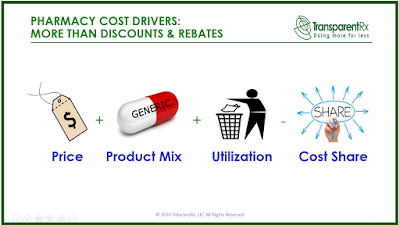
The price an employer pays for a prescription drug claim includes several components such as list prices, contractual discounts, fees and rebates. Price receives a lot of attention deservedly so. However, far too little attention is being paid to what matters most – cost. 

Click to Learn More
Product Mix refers to the complete range of products that is offered for dispensing by a pharmacy. In other words, brand, generic, specialty and biosimilar drugs make up product mix. Drug Utilization refers to the number of utilizers, days supply and channel mix for those drug products being dispensed by pharmacies. Cost Share is the member share of drug costs but that too is complicated and no longer as cut and dry as one might think.
 
Let’s take a quick look at how product mix might impact costs. Everyone knows that generic drugs are far less costly compared to brand drugs. But, did you know that for every 1% increase in GDR or generic dispense rate a plan sponsor can expect as much as a 2.5% decrease in ingredient costs? A non-fiduciary PBM is counting on you not knowing and that you will be mesmerized by their seemingly larger rebate and discount guarantees. 
 
In the case of poor product mix, the trade off is that you will overpay when GDRs hover in the 80% – 86% range despite big rebates. The non-fiduciary PBM benefits from its share of rebates on brand drugs that never should have been dispensed in the first place. Not only is the non-fiduciary PBM counting on you being mesmerized by unreasonably high discounts and rebates, it is counting on you not placing a dollar value on poor product mix.

Tuesday Tip of the Week: A PBM Proposing Anything Short of Full Disclosure is a Non-Starter

If you are unable to win full disclosure from a PBM, just walk away. Don’t be swayed by the PBM proposal with the biggest AWP discounts, rebate guarantees or low dispensing fees and even lower admin fees. There is a price to pay later if you choose to believe the optics in any proposal that doesn’t include full disclosure. A person who follows my newsletter and works for a large pharmaceutical manufacturer wrote this to me in an email not to long ago.

“Super commentary about the State of Ohio. We have had numberous debates internally about how purchasers are asking for transparency vs just the lowest price. Contract nomenclature often obscures the real price. We get asked often about direct contracting between manufacturer and employer. Lots of barriers but conceptually something that needs to be considered and they [employers] are not asking for a lower net price vs the PBM…just better optics!”
In 2018, Ohio’s Attorney General, Dave Yost, learned PBMs earned nearly $225 million through spread pricing between April 2017 and March 2018 while operating in Ohio Medicaid. As a result, the state canceled all PBM contracts in Medicaid that used spread pricing.
AG Yost announced a four-part proposal and called for quick action from the state’s legislature to shine a bright light on PBM contracts and cut down on hidden cash flows. Yost’s proposal calls for:
1) Drug purchases in the state to be conducted under a master PBM contract that is administered by a single contact point
2) Ohio’s Auditor of State to have full power to review all PBM contracts, purchases and payments
3) The state to prohibit nondisclosure agreements on drug pricing
4) PBMs must be fiduciaries
The truth does not reveal itself simply because a PBM says it is transparent or pass-through. Non-fiduciary PBMs know what you want to see in proposals and hide what you need to see in them. The spreadsheet can be a distraction if you allow it to be. As a self-funded employer, your truth lies in the PBM contract language.
The thing is, assessing PBM transparency is more effectively done by a trained eye. Someone who knows the ins and outs of PBM revenue models, contract loopholes and has personal knowledge of the employer’s plan goals. Most employers don’t know what they don’t know so check the ego at the door.

Tuesday Tip of the Week: Get Your Contract Definitions in Order

Non-fiduciary PBMs arbitrarily designate certain generic drugs as brand and non-specialty brand drugs as “specialty” medications. Subsequently, they jack up the price substantially and decree that these specialty drugs can be filled only at the parent-company pharmacy.

How can a PBM arbitrarily designate certain drugs as specialty medications you ask? The same way a non-fiduciary PBM might designate a generic drug as brand. It’s all about the contract definitions. In every scenario where a plan sponsor has shared their success with reducing pharmacy costs, they’ve mentioned the contract. The mention is usually very subtle unless of course you have a trained-eye then it sticks out like a sore thumb. Remove opaque definitions from your PBM contract.

Included above is a transparent definition of ‘Specialty Drug’ and one we use in our Certified Pharmacy Benefits Specialist curriculum.

Continue Reading >>