Tuesday Tip of the Week: Vertically Integrated Insurers Pivot to Protect Drug Manufacturer Revenue
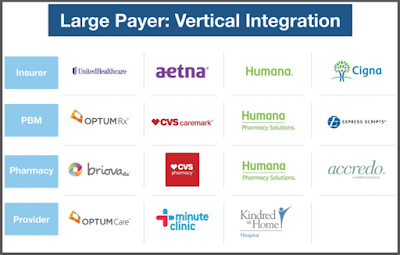
Insurer vertical integration
Click to Learn More

Humana Inc. has agreed to join a purchasing group run by rival Cigna Corp. in a move that the health insurer says will help drive down its drug costs for its commercial members. Beginning April 1, Humana will join a Cigna purchasing organization called Ascent Health Services to give it access to greater discounts from drugmakers, the companies confirmed to Bloomberg News. Ascent manages commercial rebates, the payments that drugmakers make to health plans. The agreement covers drug contracting and negotiations for Humana’s commercial business.

“This arrangement will help us leverage scale and buying power to extract deeper price discounts from drug manufacturers and advance affordability for our customers while at the same time preserve our ability to address their specific clinical needs,” Humana spokeswoman Kelley M. Murphy said in an email.

Tyrone’s Commentary:

This move and others like it are a play to hold on to the undisclosed cash flows non-fiduciary PBMs generate from drug manufacturers for rebates. In place of rebate disguising, non-fiduciary PBMs charge manufacturers fees as part of the GPO or group purchasing organization. This arrangement technically (by passing through all manufacturer revenue less GPO fees to plan sponsors) allows non-fiduciary PBMs to be in compliance with the new regulations being placed on us by departments of insurance across the country. Radical transparency requires that plan sponsors are able to verify the fees earned by PBMs in these GPO arrangements.

Cigna and Humana both sell health insurance and other medical services, including pharmacy benefits. Cigna has expanded its footprint in the pharmacy business since its 2018 acquisition of Express Scripts. In 2019, Cigna announced a three-year deal to work with Prime Therapeutics LLC, a pharmacy-benefit manager owned by Blue Cross and Blue Shield plans. Cigna executives have described how working with outside partners like Prime can increase purchasing leverage with drugmakers.
<< Read More>> 

Auditor Claims Non-Fiduciary Pharmacy Benefit Manager Hiked Drug Prices by $1.6 million with Rebate Credit Program

The Lehigh County Controller’s Office reviewed Lehigh County’s prescription drug plan administered through Highmark which lost savings of almost $1.6 million, while battling a lack of transparency and openness about drug costs. The report sheds light on the middlemen of the insurance world, Pharmacy Benefit Managers or PBMs and their power.
PBM’s directly negotiate with pharmacies to determine how much they will reimburse them for the cost of their drugs and receive rebates from pharmaceutical companies to improve the likelihood that consumers will utilize a preferred drug. These rebates should in theory be passed back to the insurer, in this case, Lehigh County.  However, this process does not always occur and savings can depend in large part on the negotiation of the contract.
Lehigh County elected to choose a fixed discount structure, meaning that it received a flat rate savings for each employee on its healthcare plan. Lehigh County is self-insured. It could have elected to take full rebate value which results from savings passed from the pharmaceutical company to the Pharmacy Benefit Manager, but chose not to do this. In 2019, Lehigh County found that the actual rebate value exceeded the fixed discount by $700,000!
Tyrone’s Commentary:

Click to Learn How

If you are a self-funded employer who has relinquished rebates to the non-fiduciary PBM in exchange for a credit of some sort, whether to the medical or pharmacy benefit, you may want to seriously reconsider that decision.  Heed the words of Controller Mark Pinsley who said, “I feel like it’s just a false narrative. It’s just what they have created, like you either get this or you get this. That’s their decision. There’s no rule that says it has to be that way.” Employers must recognize that, like it or not, the buck stops with them. Patients can hardly negotiate for themselves, but employers can be much more aggressive in getting PBMs and payers to have more skin in the drug-pricing game. Employers’ weak-kneed behavior is baffling — no other group has a greater stake in buying smarter. But employers have been reluctant actors in the U.S. pharmacy distribution and reimbursement system, relying on third-parties who may not have their best interests in mind. Some companies, like Honeywell and Caterpillar, have taken tough steps to control costs, with no loss in employee satisfaction. 

“This audit exposes what many of us have known, that our healthcare system is wasteful, lacks transparency and is subject to the greed of Pharmacy Benefit Managers that are more interested in profit,” said Controller Mark Pinsley.

Tuesday Tip of the Week: Drug Manufacturer Rebates Have Never Been the Problem

The Department of Health and Human Services on Friday agreed to push back the implementation of a controversial rebate rule until 2023. The regulation would effectively ban drug makers from providing rebates to pharmacy benefit managers and insurers — a radical change in the way many drugs are priced and paid for in Medicare and Medicaid. 

Instead, drug companies will be encouraged to pass the discounts directly to patients at the pharmacy counter. The Trump administration had backed down from issuing this rule in 2019 after it was found to raise costs for seniors and the federal government, but issued the final rule in November. 

The Pharmaceutical Care Management Association, which represents pharmacy benefit managers, sued the Trump administration to stop implementation of the rule. The group, along with America’s Health Insurance Plans, argue that it would benefit drug manufacturers. A federal judge last week put the case on hold pending a review by the Department of Health and Human Services.

Tyrone’s Commentary:

Click to Learn More

For the record, I  worked for one of the big five drugmakers Eli Lilly & Co. and can tell you these people weren’t sitting around thinking of ways to take advantage of patients or payers. Sure prescription drugs can be very expensive but they’re not as costly as the hospitalization that would be required if they didn’t exist. I’m likely in the minority on this issue, but sometimes critics of drugmakers act as if drugmakers created the diseases which cause harm to people and then manufactured the drugs to profit from their own creation. 

In fact, the opposite is often true; drugmakers develop drugs for which there may be no alternative other than surgery, chronic pain or death in order to prolong life. Having said that, this rebate rule would have been a financial windfall for drug manufacturers. The Congressional Budget Office or CBO said as much

Employers must recognize that, like it or not, the buck stops with them. Patients can hardly negotiate for themselves, but employers can be much more aggressive in getting PBMs and payers to have more skin in the drug-pricing game. Employers’ weak-kneed behavior is baffling — no other group has a greater stake in buying smarter. But employers have been reluctant actors in the health care system, relying on third-parties who may not have their best interests in mind. Some companies, like Honeywell and Caterpillar, have taken tough steps to control costs, with no loss in employee satisfaction. 

PBMs should not be generating a single penny of revenue for themselves from rebates or any manufacturer revenue. All negotiated cost-savings should be passed fully on to third-party payers like self-funded employers. When this happens getting to lowest net cost is within reach. One benefit is less cost-shifting to employees. I don’t expect employers to start writing drug-coverage policies and doing their own contracting. But, as seasoned buyers, they know how to negotiate with suppliers, such as insurers and PBMs — and they should not be afraid to do it.