Internal Email Shows Big Three PBM Was Overcharging – And Knew It

Starting with its predecessor, a company called Catamaran that OptumRx acquired, the PBM administered prescription drugs for workers injured on the job. In all, OptumRx overcharged the bureau on more than 1.3 million claims for generic medications, the lawsuit says.
The contract, in effect from mid-2009 until the fall of 2018, called for the PBM to charge the lowest of four potential prices for generic drugs, including a measure from the Centers for Medicare and Medicaid known as the Federal Upper Limit, or FUL for short. But in a series of May 2015 emails marked as “confidential,” John Spankroy, Director of Public Sector Account Management for Catamaran, said the Federal Upper Limit was never applied, despite the contract.
Click to Read Article

Tyrone’s Commentary:
How does this go on for nearly a decade? Pharmacy Benefit Managers will provide transparency and
disclosure to a level demanded by the competitive market and generally rely on the demands of prospective clients for disclosure in negotiating their contracts. The best proponent of transparency is informed and sophisticated purchasers of PBM services. The purchaser needs to understand not only what they want to achieve in their relationship with their PBM but also the competitive market and their ability to drive disclosure of details on services important to them. Assessing transparency is done more effectively by a trained-eye with personal knowledge of the purchaser’s benefit and disclosure goals. The reason plan sponsors are overcharged is due to a gap you have in one or more of these areas:

1. Information Symmetry
2. PBM Industry Training
3. Lack of understanding in pharmacy benefit design or plan goals

Far too many brokers, PBM consultants, CFOs and HR executives are unfamiliar with the phrase “lesser of logic.” Worse yet, when given pricing sources such as AWP minus, MAC, U&C and Copayment 99% of  decision-makers, who select a PBM vendor, can’t accurately calculate their own cost with lesser of logic. That’s why something like this can go on for a decade. It really just makes me sick to my stomach. It’s time to move on from the PBM, large or small, that puts profits over doing the right thing for their clients. Find a PBM partner who proactively corrects these “mistakes” for no other reason than it’s the right thing to do.
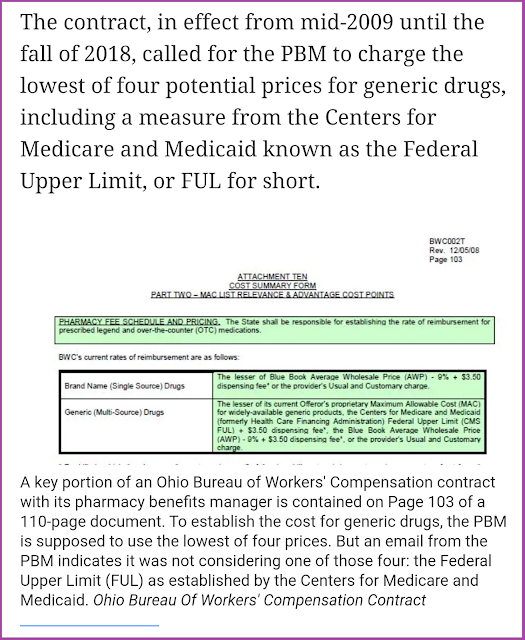
He told Susan McCreight, Senior Director of Public Sector Account Management, “Per BWC contract we are supposed to be using pricing logic that includes lower of FUL for generics. None of the BWC price schedules has FUL as a cost source.” In a separate email, Spankroy told Bryce Owens, the Illinois-based PBM’s manager for pricing and analytics, “We do not see FUL included as a cost source option.” Spankroy also acknowledged: “BWC is not aware of this (yet).”

Tuesday Tip of the Week: Focus on Lowest Net Cost Drugs

Organizations, such as the New York Department of Health, often downplay intelligence, believe their competitors to possess access to the identical information. Well, everyone also has access to a large array of fruits and vegetables, yet many don’t eat them or eat only a few. New Yorkers wastefully spent more than $706 million in Medicaid payments over three years. The state Department of Health uncovered the overcharges for pharmacy services, according to audits released by the state comptroller.

State Comptroller, Thomas DiNapoli, released five audits with several recommendations to improve the program. The comptroller criticized state health officials for failing to establish sufficient oversight and control with managed care payments, which led to the unnecessary payments. The department has worked to ensure efficient and cost-effective pharmacy services for New Yorkers dependent on Medicaid with the FFS model.

Many employers, unions, and government agencies pay large consultancies and brokerage firms to help them avoid overpaying for pharmacy services. So then how does this keep happening? There are a number of reasons including misaligned incentives, inefficient procurement and indifference just to name a few. But, the primary reason is without question a wholesale lack of education around pharmacy benefits management in general. It is education which leads employers to leveraging the four pillars to better PBM performance.

Click to Learn More
Auditors found DOH missed opportunities to lower costs on pharmacy services delivered through Medicaid managed care because officials did not ensure the use of the lowest net cost drugs, according to the comptroller. Auditors estimate $605 million was spent in unnecessary drug costs from Jan. 1, 2016, through Dec. 31, 2019. Folks access doesn’t translate into action. Buzzwords and repurposed RFPs with 200 hundred questions are not working.
A senior leader from one of the world’s largest 
pharmaceutical manufacturers emailed this to me…  
 
“We have had numerous debates internally about how purchasers are asking for transparency vs. just the lowest price. Contract nomenclature often obscures the real price. We get asked often about direct contracting between manufacturer and employer.  Lots of barriers but conceptually something that needs to be considered and they are not asking for a lower net price vs. the PBM…just better optics!”
 
Education is key to use of lowest net cost drugs in pharmacy benefit plans. Only the most sophisticated purchasers of PBM services will have the knowledge and confidence to bind lowest net costs for prescription drugs into contract language and benefit design. Hence, your competitive advantage includes executing good analysis of the correct information then deciding what all of this suggests for your organization. Those who seize the chance and develop a good plan that may reasonably be accomplished have a higher probability of getting to lowest net cost.

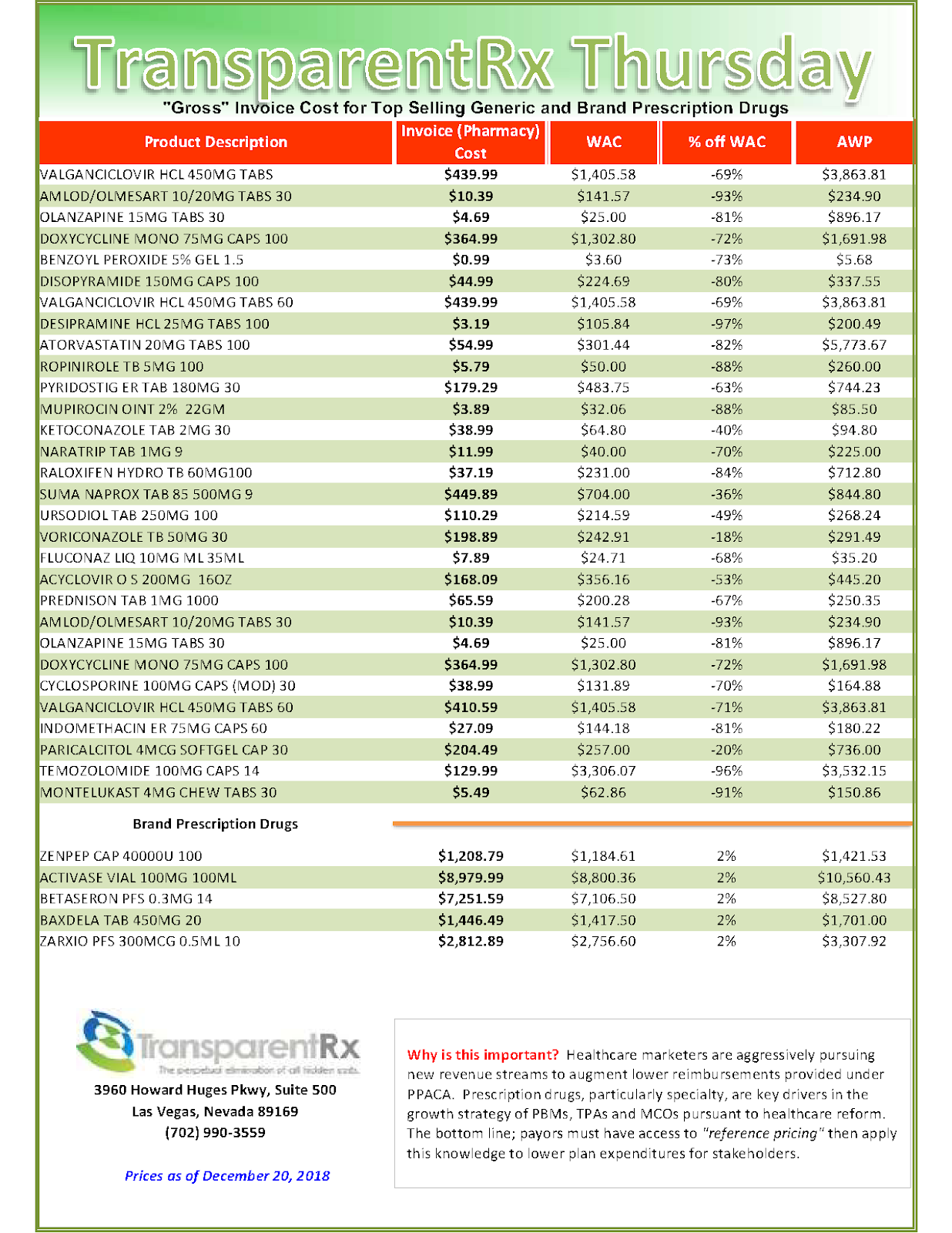
Reference Pricing: “Gross” Invoice Cost for Popular Generic and Brand Prescription Drugs (Volume 263)

This document is updated weekly, but why is it important? Healthcare marketers are aggressively pursuing new revenue streams to augment lower reimbursements provided under PPACA. Prescription drugs, particularly specialty, are key drivers in the growth strategies of PBMs, TPAs, and MCOs pursuant to health care reform.

The costs shared here are what the pharmacy actually pays; not AWP, MAC or WAC. The bottom line; payers must have access to actual acquisition costs or AAC. Apply this knowledge to hold PBMs accountable and lower plan expenditures for stakeholders.


How to Determine if Your Company [or Client] is Overpaying

Step #1:  Obtain a price list for generic prescription drugs from your broker, TPA, ASO or PBM every month.
 

Step #2:  In addition, request an electronic copy of all your prescription transactions (claims) for the billing cycle which coincides with the date of your price list.

Step #3:  Compare approximately 10 to 20 prescription claims against the price list to confirm contract agreement. It’s impractical to verify all claims, but 10 is a sample size large enough to extract some good assumptions.

Step #4:  Now take it one step further. Check what your organization has paid, for prescription drugs, against our acquisition costs then determine if a problem exists. When there is more than a 5% price differential for brand drugs or 25% (paid versus actual cost) for generic drugs we consider this a potential problem thus further investigation is warranted.

Multiple price differential discoveries mean that your organization or client is likely overpaying. REPEAT these steps once per month.

— Tip —

Always include a semi-annual market check in your PBM contract language. Market checks provide each payer the ability, during the contract, to determine if better pricing is available in the marketplace compared to what the client is currently receiving.

When better pricing is discovered the contract language should stipulate the client be indemnified. Do not allow the PBM to limit the market check language to a similar size client, benefit design and/or drug utilization. In this case, the market check language is effectually meaningless.

Reference Pricing: “Gross” Invoice Cost for Popular Generic and Brand Prescription Drugs (Volume 250)

This document is updated weekly, but why is it important? Healthcare marketers are aggressively pursuing new revenue streams to augment lower reimbursements provided under PPACA. Prescription drugs, particularly specialty, are key drivers in the growth strategies of PBMs, TPAs, and MCOs pursuant to health care reform.

The costs shared here are what the pharmacy actually pays; not AWP, MAC or WAC. The bottom line; payers must have access to actual acquisition costs or AAC. Apply this knowledge to hold PBMs accountable and lower plan expenditures for stakeholders.


How to Determine if Your Company [or Client] is Overpaying

Step #1:  Obtain a price list for generic prescription drugs from your broker, TPA, ASO or PBM every month.
 

Step #2:  In addition, request an electronic copy of all your prescription transactions (claims) for the billing cycle which coincides with the date of your price list.

Step #3:  Compare approximately 10 to 20 prescription claims against the price list to confirm contract agreement. It’s impractical to verify all claims, but 10 is a sample size large enough to extract some good assumptions.

Step #4:  Now take it one step further. Check what your organization has paid, for prescription drugs, against our acquisition costs then determine if a problem exists. When there is more than a 5% price differential for brand drugs or 25% (paid versus actual cost) for generic drugs we consider this a potential problem thus further investigation is warranted.

Multiple price differential discoveries mean that your organization or client is likely overpaying. REPEAT these steps once per month.

— Tip —

Always include a semi-annual market check in your PBM contract language. Market checks provide each payer the ability, during the contract, to determine if better pricing is available in the marketplace compared to what the client is currently receiving.

When better pricing is discovered the contract language should stipulate the client be indemnified. Do not allow the PBM to limit the market check language to a similar size client, benefit design and/or drug utilization. In this case, the market check language is effectually meaningless.

“Don’t Miss” Webinar: How to Slash PBM Service Costs, up to 50%, Without Changing Vendors or Benefit Levels

How many businesses do you know want to cut their revenues in half? That’s why traditional pharmacy benefit managers don’t offer radical transparency and instead opt for hidden cash flow opportunities such as rebate masking. Want to learn more?


Here is what some participants have said about the webinar.

“Thank you Tyrone. Nice job, good information.” David Stoots, AVP

“Thank you! Awesome presentation.” Mallory Nelson, PharmD

“Thank you Tyrone for this informative meeting.” David Wachtel, VP

“…Great presentation! I had our two partners on the presentation as well. Very informative.” Nolan Waterfall, Agent/Benefits Specialist


A snapshot of what you will learn during this 30 minute webinar:

  • Hidden cash flows in the PBM Industry such as formulary steering, rebate masking and differential pricing 
  • How to calculate cost of pharmacy benefit manager services or CPBMS
  • Specialty pharmacy cost-containment strategies
  • The financial impact of actual acquisition cost (AAC) vs. maximum allowable cost (MAC)
  • Why mail-order and preferred pharmacy networks may not be the great deal you were sold
Sincerely,
TransparentRx
Tyrone D. Squires, MBA  
3960 Howard Hughes Pkwy., Suite 500  
Las Vegas, NV 89169  
866-499-1940 Ext. 201


P.S.  Yes, it’s recorded. I know you’re busy … so register now and we’ll send you the link to the session recording as soon as it’s ready.