Tip of the Week: PBMs that make money through hidden cash flows do so at the expense of client savings and health of members

The PBM works with the client to decide the pharmacy benefit that it will offer, including the drugs that will be covered, the beneficiary’s cost-sharing requirements, and the pharmacy network. The client then retains the PBM to administer the pharmacy benefit for its members or employees. How much cash the PBM actually generates for itself, on a per client basis, is information that is overlooked in far too many PBM contracts.

Is it unreasonable to know exactly how much revenue your PBM is keeping for itself on the services it provides to your organization? Traditional and pass-through pharmacy benefit managers alike will bark at this notion. The reality is clear: non-fiduciary pharmacy benefit managers intentionally make it difficult to ascertain their management fee. They know what you’ll learn will not allow them to maintain the status quo.

RETAIL COST COMPONENTS

Administrative Fees

  • These are the fees PBMs charge for claims adjudication (processing). They are often artificially low, from $0.00 to $1.50 per claim, but later augmented with cash flows from hidden sources. If you are not paying at least $5.00 – $10.00 per claim, you can be certain that the PBM is making up the difference elsewhere. This practice is frequently referred to as ballooning.
  • Administrative fees associated with claims adjudication are different from the administrative fees paid by pharmaceutical manufacturers to PBMs. More on that in the rebate section of this white paper.


Dispensing Fees

The professional dispensing fee, which compensates for costs beyond the ingredient cost of a covered outpatient drug, is gained at the point of sale or service each time a covered outpatient drug is dispensed. The Centers for Medicare & Medicaid Services (CMS) states that it only includes pharmacy costs related to ensuring that appropriate covered outpatient drug possession is transferred to a beneficiary. According to the CMS, reasonable expenses related to a pharmacist’s time that fall under the category of pharmacy costs include, but are not limited to:

  • Looking up information about a patient’s coverage on the computer
  • Carrying out drug use reviews and preferred drug list review activities
  • Measuring or mixing the covered outpatient drug
  • Beneficiary counseling
  • Physically giving the beneficiary their completed prescription
  • Special packaging
  • Overhead associated with facility and equipment maintenance necessary to the pharmacy’s operation

The CMS also adds that administrative costs incurred by operating covered outpatient drug benefits—including systems costs for interfacing with pharmacies—are not a part of the professional dispensing fee. This detailed list of pharmacist activities included in the professional dispensing fee is intended to reflect the value of practitioner work.

Where an acquisition cost–based system has been implemented in PBM retail pharmacy networks, the dispensing fees have been in the $9 to $15 range per prescription. Like administrative fees, dispensing fees can be artificially low. This leads to the PBM making up for the lost revenue somewhere else.


Spread Pricing – Hidden Cash Flow


Brand Ingredient Cost

Despite what the name may suggest, the AWP is not the average of the amounts actually paid by retail pharmacies or PBMs to wholesalers for a particular drug.  Instead, it is a published wholesale price or “list price” suggested by the manufacturer of the drug. A wholesaler may sell specific drugs to all pharmacies at prices below the AWP or may grant a general discount to certain pharmacies. 

Thus, although PBMs frequently use the AWP as a cost basis for pricing purposes, it does not represent the actual cost of acquiring the drug.  It is merely a wholesale list price that can be used as a benchmark in comparing retail and wholesale prices.  A PBM may contract with a retail pharmacy at AWP minus 20% and then offer its client an average AWP discount of minus 17%. This is called differential contracting also referred to as differential pricing. 

How PBM “rebate walls” impact drug spending, patient care and competition [Weekly Roundup]

News and notes from around the interweb:
  • The Value of a Hub in a Limited Distribution Specialty Pharmacy Network. A hub can play an essential role in coordinating the specialty pharmacy limited distribution network. Although specialty pharmacies may be able to offer some of the services that a hub provider does, a hub can standardize patient and provider support across the network and coordinate referrals to ensure patients end up at their most appropriate destination.
  • PBM Settles Two Pharmacy Benefit Probes for $71 Million. The settlements, announced on Thursday in statements from the attorneys general in Illinois and Arkansas, are related to claims the pharmacy benefit management business inflated drug costs. The company has resolved similar disputes with Ohio and Mississippi and has reserved $1.1 billion to cover the claims.

The Certified Pharmacy Benefits Specialist (CPBS) educational offering includes knowledge that is critical to effective management of the pharmacy and medical drug benefit. If you want to learn more, click here.

Costco approach could have saved Medicare $2.6 billion in drug spending, analysis shows

Medicare spent billions more money on generic drugs for its beneficiaries than warehouse chain Costco did for the same drugs, according to an analysis published Tuesday. This overspending hit $2.6 billion in 2018, Erin Trish, associate director of the University of Southern California’s Schaeffer Center for Health Policy and Economics, and colleagues wrote in a letter to the Journal of the American Medical Association’s JAMA internal Medicine.

Figure 1: Five P’s of Decision-Making

Tyrone’s Commentary:

Purchasers of PBM services need to recognize that smaller PBMs can provide similar or better levels of service at a lower cost. Your jobs are not at risk for trying a different approach when the current strategy is severely flawed. In fact, just the opposite is true. Save your company a few million bucks and you have grounds for a pay raise and/or promotion. What drives decisions in your PBM selection process? The best leaders, with P&L responsibility, make decisions at the top of the pyramid (see figure 1). Assess yourself as a plan sponsor. 

They compared the amount Medicare pays for common generic prescriptions in its Part D prescription coverage with prices available to patients without insurance at Costco for 184 common generic drug products. “Medicare overspent by 13.2% in 2017 and 20.6% in 2018 compared with Costco member prices for these prescriptions,” they wrote. “Total overspending increased from $1.7 billion in 2017 to $2.6 billion in 2018.”

Continue Reading>>

Study Finds Non-Fiduciary PBMs are Draining Florida’s Medicaid Funds

A study exploring Florida’s prescription drug costs through the Medicaid program found that pharmacy benefit managers (PBMs) profited $89 million dollars, mostly from a spread pricing contract scheme that charges the state higher cost than will be disbursed to the pharmacist.

Click to Learn More

Florida’s Medicaid program is contracted out to private healthcare companies like CVS Caremark, Humana, etc. Those private companies then take Medicaid dollars and draw up contracts with pharmacies around the state. PBMs play the role of negotiating drug prices between pharmacy suppliers and payers; they have an outsize stake in what consumers pay for their prescription drugs.

PBMs in Florida operate in 2 ways depending on the county – pass-through or spread. Pass-through pricing reimburses pharmacists the cost of the drug, while PBMs take a small fee. Spread, on the other hand, reimburses a pharmacy a different amount for the drugs than what it charges the state. Kevin Duane of SPAR (Small business Pharmacies Aligned for Reform) who finds it “indefensible” that the PBMs under pass-through contracts filled 2 million more prescriptions and made tens of millions of dollars less than those under spread contracts.

Commissioned by the state Agency for Healthcare Administration (AHCA), the study found that spread pricing contracts pay pharmacists less in reimbursement and keep, on average, 9.5% of the transaction, whereas pass-through models take a $1.45 administration fee and reimburse pharmacists the full cost.

<<Continue Reading >>

Ohio Requesting Bids for Administrator to Oversee its Pharmacy Benefit Program

The Ohio Department of Medicaid on Thursday started the process of hiring a private administrator to oversee its $3 billion pharmacy benefit program. The department requested proposals for a pharmacy operational support vendor to help design its program and provide financial oversight once it’s up and running. Medicaid created the new post as part of a broader overhaul of its managed care program. 

Find Out More

In addition to rebidding contracts with private managed care organizations that oversee the program, the state agency is also replacing five pharmacy benefit managers hired by those private organizations to process claims with one company hired by the state and monitored by the administrator. The added oversight comes after a report showed PBMs billed the state far more than they paid pharmacists and kept the difference, allowing them to receive $224 million in one year — an amount generated by PBMs charging three to six times the standard rate, according to an independent analysis.

Tyrone’s Commentary:  

Your pharmacy benefit manager owes you nothing. In its most simplistic form it is merely a facilitator of goods and services. At best, it is your adviser offering suitable goods and services but not necessarily the best goods or services. To owe its client something, the PBM would have to act as a fiduciary. Have you noticed how often PBMs get sued but rarely lose in court? Employers believe that PBMs owe it something the courts say otherwise. You see non-fiduciary PBMs generally rely on the demands of its clients for how much cost savings they will provide. Moreover, non-fiduciary PBMs provide disclosure of important contract details to a level demanded by the competitive market. In other words, non-fiduciary PBMs have learned how to leverage the purchasing power of the unsophisticated plan sponsor to their financial advantage. The truth is most, if not all, of the excessive costs embedded in non-fiduciary PBM service agreements can be eliminated if stakeholders (HR execs, CFOs, benefits consultants, brokers etc…) concern themselves more with self-education and accountability and less with self-preservation. If I here one more time “no one has ever been fired for hiring Express Scripts”?. The state of Ohio was humbled and now has a plan to win full disclosure and eliminate overpayments to non-fiduciary PBMs. You could establish a POSV or just hire a fiduciary-model PBM and achieve two aims at once – eliminate PBM overpayments and do away with duplicative consulting fees. What is your pharmacy benefits management strategy?

“The POSV (pharmacy operational support vendor) will ensure monetary incentives are properly and fairly aligned, eliminate self-dealing and steering, and monitor and close potential pricing or rebate loopholes,” said Medicaid Director Maureen Corcoran. “In short, the POSV ensures that the fox is no longer guarding the chicken coop.” The administer will operate independently from the pharmacy benefit manager, providing oversight and ensuring pharmacists are paid accurately for the prescriptions they fill.

<<Continue Reading>>

Tuesday Tip of the Week: Non-Fiduciary PBM Rent-Seeking Behavior Eliminates Their Price Advantage

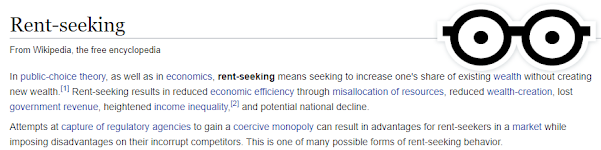
Rent-seeking is a term economists use to describe an organization’s ability to generate above average economic returns without providing any relative incremental value. Wikipedia may explain it a bit better.

Wikipedia Definition

The simplest definition of rent-seeking is to expend resources in order to gain wealth by increasing one’s share of currently existing wealth instead of trying to create wealth. Since resources are expended but no new wealth is created, the net effect of rent-seeking is to reduce total social wealth. It is important to distinguish between profit-seeking and rent-seeking.

Profit-seeking is the creation of wealth, while rent-seeking is the use of social institutions such as the power of government to redistribute wealth among different groups without creating new wealth. Rent-seeking generally implies extraction of uncompensated value from others without making any contribution to productivity.

The origin of the term refers to gaining control of land or other pre-existing natural resources. In a modern economy, a more common example of rent-seeking would be political lobbying to obtain government benefits/subsidies or to impose burdensome regulations on competitors in order to increase market share.

Studies of rent-seeking focus on efforts to capture special monopoly privileges such as manipulating government regulation of free enterprise competition. The term monopoly privilege rent-seeking is an often-used label for this particular type of rent-seeking. Often-cited examples include a lobby that seeks tariff protection, quotas, subsidies, or extension of copyright law.

How do traditional and pass-through PBMs employ a rent-seeking methodology?
 
Generating more than $400 billion annually, the PBM industry offers an extraordinarily valuable service, providing pharmacy benefits to nearly 250 million Americans. Unfortunately, very few people outside of the industry fully understand how it makes its money.
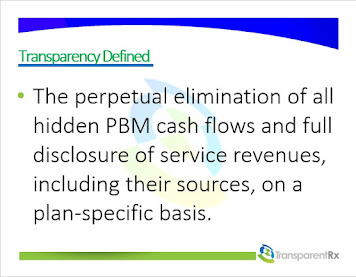
PBM clients include, but are not limited to, commercial and public sector employers, unions, health plans and health systems just to name a few. All of the different PBM business models will profess how much money they can help plan sponsors save or that they are the most effective at improving your pharmacy benefit plan. However, very few of them share how much revenue they retain. In other words, disclose their management fees.
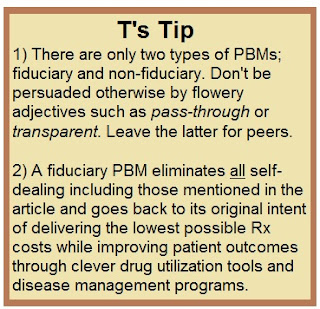
Only two PBM business models will share their management fee – fiduciary or radically transparent PBM models. I mean, who are we kidding?  Traditional, pass-through, and transparent PBM business models are for the most part the same. Do any of them reveal how much money they are being paid for their services?
Think about this for a second. Contracts between pharmacy benefit managers and pharmaceutical manufacturers and pharmacies are pretty much set in stone. Unless a PBM significantly outperforms its contract, the terms between the PBM and manufacturer or rebate aggregator will not change until the contract ends.

<<Continue Reading>>