Most employers do not lose sleep over concert ticket fees. They should still pay attention to Ticketmaster. The reason is simple. Ticketmaster is being criticized for operating in a way that many buyers see as unfair, confusing, and self-protective. According to The Guardian, senators accused the company of raising other charges after rules targeted hidden fees, calling it a bait-and-switch approach rather than real reform. At the same time, the Department of Justice alleges that Live Nation-Ticketmaster’s conduct harms fans, artists, smaller promoters, and venues by weakening competition and preserving its control over the market.
Commercial employers should see the parallel immediately.
The traditional PBM model often works the same way. A large intermediary controls key parts of the transaction, tells the buyer it is delivering savings, and then makes it difficult to determine where money is being earned, retained, or shifted. The product is different, but the outcome can look familiar: the buyer pays more than expected, the contract is hard to interpret, and the middleman keeps defending its role as essential.
That is why the Ticketmaster story matters. It is not really about concerts. It is about what happens when opacity becomes part of the business model. The DOJ says Live Nation-Ticketmaster used exclusionary conduct, long-term exclusive arrangements, and other tactics that limited competition and kept venues from using rival providers. That matters because concentrated control often weakens pricing pressure, blunts innovation, and leaves buyers with fewer practical options than they appear to have on paper.
Employers dealing with PBMs should recognize the pattern.
Here are the similarities.
- Who is harmed. In Ticketmaster’s case, the DOJ says the harm falls on fans, artists, smaller promoters, and venue operators. In the PBM market, the comparable groups are employers, plan members, independent pharmacies, and sometimes even consultants or advisers who cannot get complete, reliable claims and pricing data. In both settings, the end buyer and surrounding market participants lose leverage when one intermediary controls too much of the flow.
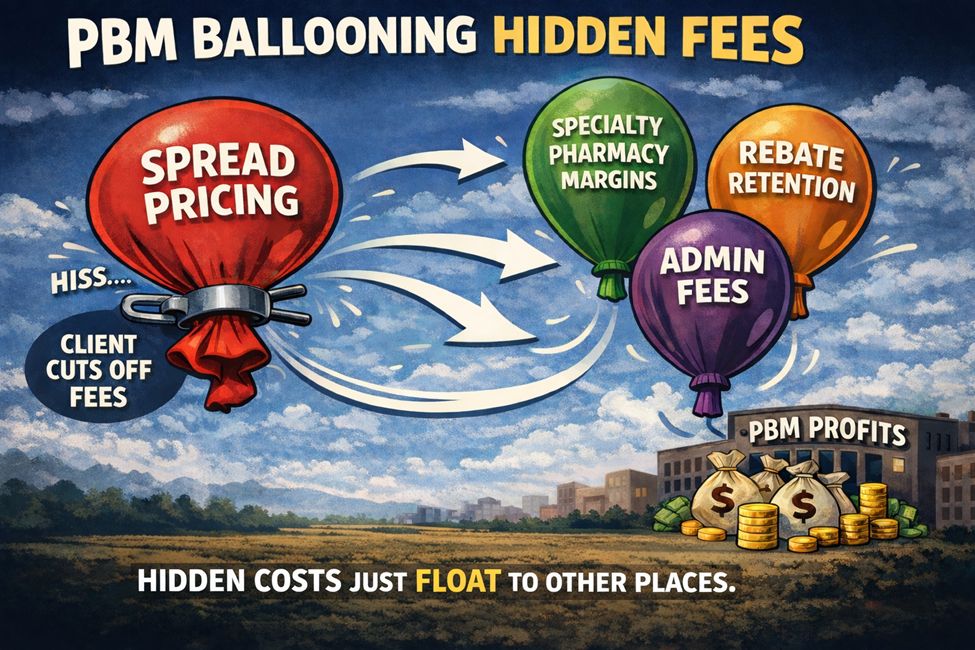
- How they are harmed. The Guardian reports that after hidden-fee rules took effect, Ticketmaster found other ways to preserve revenue. Employers often face the same kind of economic shell game in pharmacy benefits. A PBM may promote rebate improvements or stronger discounts in one area while recovering margin somewhere else through spread pricing, retained rebates, specialty pharmacy markups, inflated dispensing economics, administrative fees, or favorable steering into affiliated channels. The issue is not just high cost. It is cost that moves around faster than the buyer can track it.
- Why buyers miss it. Most employers do not review PBM economics line by line. They rely on RFPs, consultant scorecards, guarantee sheets, and headline discount terms. That is where the problem starts. A PBM can look competitive on AWP discounts or rebate guarantees while still retaining value through contract definitions, exclusions, data blind spots, specialty carve-in rules, or opaque reconciliation methods. Ticketmaster’s fee criticism is a useful reminder that disclosure alone does not solve much if the structure still lets the intermediary protect margin elsewhere.
- How competition gets weakened. The DOJ alleges that Live Nation-Ticketmaster used its market position and exclusive deals to lock out rivals and reduce real competition. Employers often see a softer but similar version in PBM contracting. Incumbents bundle services, tie data to proprietary systems, make implementation difficult, and use affiliate arrangements to keep clients inside their ecosystem. That does not always violate antitrust law, but it does make the market less open and less accountable.
- Why trust breaks down. Buyers can tolerate complexity for a while. What they do not tolerate is the feeling that complexity was designed to keep them from seeing the truth. Once employers begin to suspect that savings in one bucket are being offset by profit-taking in another, the conversation changes. It stops being about vendor performance and starts being about whether the buyer has been managed or misled. That is where reputational damage begins. This is an inference from the reported Ticketmaster fee response and the DOJ’s broader allegations about market conduct.
Employers should also be clear about the likely PBM equivalents of Ticketmaster’s fee reshuffling.
If one revenue stream gets squeezed, margin often reappears somewhere else. It can show up in spread pricing on generic drugs. It can show up in lower rebate pass-through percentages than the client assumed. It can show up in specialty drug dispensing margins through affiliated pharmacies. It can show up in administrative fees, data access restrictions, formulary management payments, or contract language that makes audits technically possible but practically useless. That is why a single “savings” metric is rarely enough. A PBM that loses easy profit in one place may simply hunt for it in another.
This is where employers need to stop thinking like purchasers of administrative services and start thinking like fiduciaries. A fiduciary standard of care means asking whether the pharmacy benefit is being managed for the exclusive benefit of the plan and its participants, or whether the structure rewards the intermediary first. That is not a philosophical question. It is a financial one. If the PBM’s compensation rises when the plan spends more, uses more expensive channels, or accepts lower transparency, the employer has a governance problem whether it wants to admit it or not.
Here are practical steps employers can take.
- Evaluate total net cost, not isolated discounts. Rebate totals and AWP discounts can be manipulated as standalone talking points. Review ingredient cost, rebates, dispensing fees, administrative fees, specialty pharmacy economics, and every retained revenue stream together.
- Force plain-English contract terms. If your team cannot explain how the PBM makes money in two minutes, the arrangement is too opaque. Definitions around spread pricing, rebate pass-through, specialty pharmacy, audit rights, and manufacturer revenue should be explicit and easy to understand.
- Test whether savings are real or relocated. After any contract change or “enhancement,” ask one question: did total plan cost go down, or did margin simply move to another line item?
- Benchmark specialty separately. This is where many employers lose control. Specialty claims are often the easiest place for a PBM to preserve margin while still reporting attractive overall contract terms.
- Strengthen audit rights and use them. Audit language that cannot produce actionable data is window dressing. Employers should insist on timely access to claims detail, rebate detail, channel economics, and affiliate compensation.
- Reduce dependence on one black-box vendor. The more functions the PBM and its affiliates control, the harder it becomes to challenge pricing and performance. Carve-outs, pass-through arrangements, and direct contracting deserve serious evaluation.
- Hold advisers to the same standard. Employers should expect consultants and brokers to explain not just what a PBM promises, but how the economics work underneath the promises.
Ticketmaster is now dealing with the kind of scrutiny that shows up after buyers decide the system may be working against them. PBMs are on similar ground. Once employers realize that “savings” can be manufactured on paper while money leaks elsewhere, patience runs out. Regulators may act. Litigators may act. Markets may shift. But none of that helps an employer that waited too long to look closely.
The better move is to get ahead of it.
The core lesson is not that PBMs are identical to Ticketmaster. They are not. The lesson is that any middleman that depends on complexity, limited visibility, and shifting revenue streams should expect more skepticism over time. Employers do not need to wait for a subpoena, a lawsuit, or a Senate hearing to respond. They already have enough reason to demand clarity now. That is what a fiduciary buyer does. It does not accept savings claims at face value. It follows the money.
How We Can Work Together
Whether you’re a plan sponsor trying to get control of pharmacy spend, or a broker guiding clients through PBM decisions, education is the fastest way to improve outcomes. If you want a focused, high-value session your team can actually use, here are several ways we can work together.
Option 1: Get Certified
American College of Benefit Specialists (ACoBS) equips benefits professionals with practical knowledge across pharmacy, medical, retirement, and voluntary benefits. Organizations working with ACoBS-certified consultants gain better plan oversight, stronger vendor accountability, and more disciplined cost control. The certification signals a clear commitment to fiduciary guidance and protecting plan assets.
Option 2: Book a Webinar
A clean, educational session for employers, brokers, or TPAs. We’ll cover the most common PBM profit tactics, how to spot contract red flags, and what a fiduciary standard of care looks like in pharmacy benefits. Great for client education and thought leadership.
Option 3: Join the Virtual Roundtable
Bring your internal team (HR, Finance, and Benefits) or your broker group. I’ll lead a live discussion focused on PBM oversight, cost drivers, and what to ask your PBM right now. You’ll leave with a short action list you can use immediately.
Option 4: Get a Quote
Pharmacy benefits now rival medical spend for many plans. Yet most are still governed by contracts few have fully read and pricing models few can clearly explain. That is a fiduciary risk, not just a cost issue.
If you want lower spend, tighter oversight, and alignment you can defend in front of a board or audit committee, act with intent. Certify your team. Educate your clients. Pressure test your PBM.